Saturday, January 18, 2014

The EC has shelved plans for a new directive, following lobbying from David Cameron, and is instead preparing to announce guidelines that shale drillers say will not inhibit the push for fracking as they simply echo existing UK rules.
The EC is also preparing to say that shale gas could cap or even cut energy prices and bring economic benefits to Europe, according to a draft copy of its communication, due to be issued later this month. Ministers also unveiled plans intended to bolster support for fracking by allowing local councils to keep 100pc of business rates from the controversial process, rather than the usual 50pc. 
But they faced fresh warnings from the Local Government Association that the package of benefits offered to communities by shale gas explorers - including a 1pc share of revenues - would be insufficient to win public support.
Some EU countries had been pushing for new laws because, as the EC admits in the draft communication, “EU environmental legislation was not developed to specifically address the risks associated with the ‘fracking’ technique”.
But Mr Cameron had appealed to the EC not to opt for legislation as shale explorers had feared the lengthy process of drawing up new laws would have delayed drilling.
Michael Fallon, the energy minister, said on Sunday that Britain’ hopes for a shale boom could yet be “choked by faceless Brussels bureaucrats” because of the plans for a “cumbersome new EU directive on shale”. “They are proposals that would take years to finalise and would add damaging uncertainty and crippling costs to business,” he wrote in the Sun, adding that “the next few weeks will be critical” in fighting off the plans.
Instead of such a law, the draft EC document adopts a “recommendation” including “key principles which, if fully applied, would contribute to enabling shale gas actitivies, while ensuring that climate and environmental safeguards are in place”.
The EC will “closely monitor the implementation of the recommendation” and report to the Eu Parliament and Council “within 18 months”. Only then “if necessary” would it reconsider legislation.
The recommendations include conducting strategic environmental assessments, monitoring the impact on water, air and seismicity, and providing transparent information about chemicals used in fracking.
Senior industry sources said that all the recommendations in the guidelines were in line with existing UK practice.
Commission officials confirmed that plans for a new EU directive have been shelved indefinitely. “I can confirm that as part of our climate and energy 2030 package in January, the commission will present firm guidance. However, the commission will not propose draft legislation,” said an official.
The draft EC document argues that “while the EU will not become self-sufficient in natural gas”, shale gas could “compensate the decline in the EU’s conventional gas production”.
It says that it could “offer member states with a high import dependency the possibility to diversify their energy sources and enhance their security of supply”.
It says: “The direct price effect on European regional gas markets is likely to remain moderate.... but even a moderate decrease or avoided increase in gas prices - for instance through increased negotiation power towards non-EU gas providers - would be beneficial for member states.”

Friday, January 17, 2014

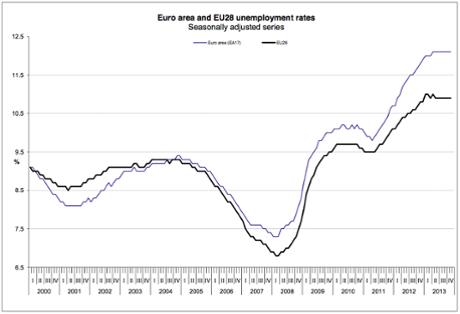
Eurozone unemployment will remain close to these record levels for some time, warns Howard Archer of IHS Global Insight.
He writes: While signs of stabilizing labor markets is relatively encouraging, unemployment remains worryingly high across the Eurozone and it seems unlikely to come down markedly any time soon.  Although the Eurozone has been growing slightly since the second quarter of 2013, economic activity will likely remain too limited in the near term at least to generate many jobs. Furthermore, while business confidence across the Eurozone has generally improved appreciably in recent months, many firms remain wary of the outlook. Firms are also aware of how difficult and costly it can still be to shed labor in some countries which can deter taking on new workers.
Eurostat, the EU's statistics office, said the eurozone's unemployment rate held steady in November at a record 12.1 percent for the eighth month running after a modest 4,000 rise in the ranks of the jobless to 19.24 million. Since September's 12.2 percent rate was revised down, 12.1 percent is now the record.
The agency also said retail sales during the month spiked by 1.4 percent, way ahead of predictions in the markets for a more modest increase of around 0.3 percent. The rise was the biggest since November 2011.
Though much of the increase was due to a 2.1 percent rise in France, where consumers may have brought forward purchases ahead of a sales tax rise, analysts said the figures suggest households are increasingly confident that the financial crisis is past its worst and that the recovery has legs.
The increase followed two monthly declines and was fairly broad-based across the eurozone. The Iberian economies of Spain and Portugal did particularly well, posting gains of 1.9 percent and 3.1 percent, respectively.
"The outlook is starting to brighten a little for eurozone consumers," said James Howat, European economist at Capital Economics.
Despite the signs of improvement, the eurozone continues to face huge problems and most economists think it will remain the laggard of the world economy.
Among the challenges will be to get unemployment down and prevent deflation, a sustained fall in prices that can encourage consumers to put off purchases in the hope of getting better bargains further down the line.
EU unemployment rate
Photograph: Eurostat

Wednesday's figures highlighted disparities across the eurozone, which had 17 members in November the bloc grew to 18 members following Latvia's adoption of Europe's single currency at the start of the year. While countries like Germany and Austria have unemployment rates around 5 percent, those at the forefront of Europe's debt crisis, such as Greece and Spain, have over one in four of their people out of work. The situation among the young there is even worse, though Greece appears to be showing some improvement on that front, with 54.8 percent of those aged 15-24 out of work at last count in September, compared with 57.7 percent the previous month. Policymakers are hoping the eurozone's return to economic growth may get unemployment down. So far, the eurozone's recovery from its longest-ever though not deepest recession has been paltry but most economists are predicting a modest pick up this year, with even Greece emerging from a six-year depression that has seen its overall economic output shrink by over a fifth.
Because it takes a few months for changes in economic growth to affect the labor market, and as many governments continue to make spending cuts to get public finances into shape, most economists think it will be some time before there's a real drop in unemployment. "It is good news that labor shedding has receded so that the number of unemployed is no longer rising, or at least not by much," said Marie Diron, a senior economist adviser at EY, formerly Ernst & Young. "But we think that it will be a long while before we see a fall in unemployment." AP 

Thursday, January 16, 2014

....withdrawn from circulation in 15 weeks' time.

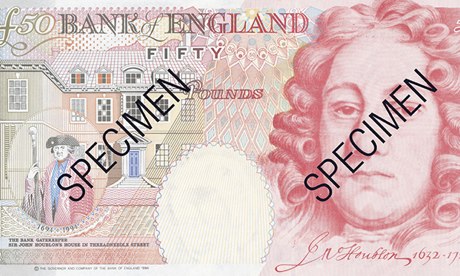
Houblon  50 note to be withdrawnAround 63m £50 banknotes bearing the portrait of the first governor of the Bank of England Sir John Houblon are to be withdrawn from circulation in 15 weeks' time.
From April 30, only the £50 note which celebrates the 18th century business partnership of entrepreneur Matthew Boulton and engineer James Watt, who helped forge the Industrial Revolution, will hold legal tender status, the Bank of England said.
Around 224m £50 notes worth £11.2bn are in circulation, of which the Bank estimates 63m with a total value of £3.2bn are Houblon notes.
From May onwards, retailers are unlikely to accept the Houblon notes as payment, but most banks and building societies will still allow customers to deposit them into their accounts. However, agreeing to exchange the notes after 30 April will be at the discretion of individual institutions.
Barclays, NatWest, Royal Bank of Scotland (RBS), Ulster Bank and the Post Office have agreed to exchange the older-style £50 notes for both customers and non-customers up to the value of £200 until 30 October.
In a video placed on YouTube, Victoria Cleland, head of notes division at the Bank, advises people: "If you have any Houblon £50 notes, it's best to spend, deposit or exchange them before 30 April."
If people do not pay in or exchange the Houblon £50 notes by the withdrawal deadline, this does not mean that the notes then become worthless. All notes that have been issued by the Bank whose legal tender status has been withdrawn are covered by its "promise to pay". This phrase dates back to times when notes could be swapped for gold. It means that people can, at any time, obtain the face value of a note that has been withdrawn by exchanging it at the Bank of England in London. There is no fee for the service and banknotes of this type can be exchanged by post or in person.
Legally the Bank of England is only required to give one month's notice of an intention to withdraw legal tender status. It gave a similar three-month notice period to its latest announcement when a £20 note featuring composer Edward Elgar was withdrawn in 2010.
Sir John Houblon was appointed as the Bank's first governor in 1694 and the £50 banknote celebrating him was first issued in 1994, to coincide with the Bank's 300th anniversary.
The withdrawal of the Houblon note is part of the Bank's regular review of notes to make them more secure and combat fraud. The Boulton and Watt note, which was brought into circulation in November 2011, was the first introduced by the Bank to feature a green "motion thread", which has five windows featuring the pound symbol and the number 50, which move up and down when the note is tilted from side to side.
In December, the Bank announced that it plans to issue plastic banknotes for the first time from 2016, when a new £5 note featuring Sir Winston Churchill appears.
A £10 note featuring Jane Austen to follow around a year later will also be made from polymer rather than the cotton paper currently used.
In a major intervention, the backbenchers have written to the Prime Minister urging him to change the law to give the Commons authority to block new EU legislation and repeal existing measures that threaten Britain’s “national interests”.
Such powers would enable the Government to reverse the spread of human rights law, relieve businesses of red tape from Brussels and regain control over immigration, they say. They believe the veto is possible with a new Act of Parliament.
At least six more Tory MPs back the letter, but are unable formally to put their names to its demands – some because they are in government jobs.
David Cameron has promised to renegotiate the terms of Britain’s relationship with Brussels and put the arrangement before voters in a referendum by 2017, which would give the public the option to leave the European Union.

Wednesday, January 15, 2014

Slapping the incompetents and impostors...The EU dilentants...

Chancellor George Osborne has raised the prospect of Britain leaving the European Union if the 28-nation bloc fails to undertake fundamental reforms to improve competitiveness, create jobs and protect the rights of countries which are not in the single currency. And he suggested that if the UK was unable to secure support for reform from all EU states, it was ready to press ahead with a smaller group of like-minded countries under what he termed ''enhanced co-operation''. In a keynote speech, the Chancellor said that the treaties underpinning the EU were no longer ''fit for purpose'' and failure to reform will condemn the continent to a future of economic crisis and decline, warning: ''We can't go on like this.'' Mr Osborne stressed the Government's determination to renegotiate the terms of British membership in order that the UK can remain in the EU following a referendum in 2017.
He said that growing integration of the eurozone had posed threats to the position of Britain's financial services industry and the City of London and said it was ''absolutely necessary'' to introduce proper legal protection of the rights of EU states which are not in the Eurozone....The financial crisis of 2008 had dramatically exposed the underlying weakness of the European economy, he also said. ''We knew there was a competitiveness problem in Europe before the crisis. But the crisis has dramatically accelerated the shifts in the tectonic economic plates that see power moving eastwards and southwards on our planet,'' said the Chancellor.
''Over the last six years, the European economy has stalled. In the same period, the Indian economy has grown by a third. The Chinese economy by 50%. Over the next 15 years Europe's share of global output is forecast to halve.
''Make no mistake, our continent is falling behind. Look at innovation, where Europe's share of world patent applications nearly halved in the last decade. Look at unemployment, where a quarter of young people looking for work can't find it. Look at welfare.
''As (German chancellor) Angela Merkel has pointed out, Europe accounts for just over 7% of the world's population, 25% of its economy, and 50% global social welfare spending.''


Tuesday, January 14, 2014

Italian joblessness has hit a fresh high, underlining the challenge for the country’s fragile coalition in convincing the international markets it is on the path to recovery.
Unemployment hit 12.7pc in November, up from October’s 12.5pc and the highest on record. Youth unemployment, at 41.6pc, is also at an all-time high.
The figures show that tentative signs of recovery in Italy's recession-battered economy have failed to benefit the labour market.
Italy hopes to raise €470bn (£387bn) from bond sales this year, similar to its 2013 funding target. But the government is under pressure to attract more interest from foreign buyers, since Italy’s domestic banks are expected to slow their purchases of sovereign debt this year.
The Treasury is confident that high yields on its debt will entice international buyers. But political gridlock within the country’s fractious coalition is likely to put off investors looking for reassurance Italy can carve a path to economic recovery.

Monday, January 13, 2014

Spain, where unemployment, at 26.7pc, is second only to that of Greece, yesterday (Wed) increased its 2014 borrowing target to €242bn. But unlike Italy, signs are mounting that the country is headed for a full-blown recovery. Investors took Madrid’s raised ambition in their stride, pushing Spanish borrowing costs to a four-year low.
“Spain possibly exemplifies best how the improving macroeconomic outlook is making the country more attractive to domestic and, more importantly, international investors,” said Antonio Garcia Pascual, economist at Barclays.
Italy, one of the only eurozone countries where unemployment rose in November, is largely to blame for the bloc’s failure to shake off record high joblessness despite emerging from recession in the third quarter of last year.
Separate figures released yesterday [Wed] showed that unemployment across the single currency bloc remained unchanged for the eighth month running at 12.1pc in November. Youth unemployment, across the bloc was 24.2pc, for the second consecutive month.