 OECD: Advanced economies grew
0.4% in last quarter: Growth has picked
up in the world’s major developed economies, with the UK and US making up for
the weakness of Japan and the eurozone. That’s
according to a new report from the Organisation for Economic Co-operation and
Development reports. It says GDP across the 33 countries who make up the OECD
area rose by 0.4% in April-June, up from 0.2% in January-March. There was “a wide spectrum of patterns across
countries”, though. Real quarterly growth in the US surged by 1%, followed by
Britain with 0.8%. Japan contracted by
1.7% as a new sales tax hit spending, Germany shrank by 0.2% and France was
flat. Over to Greece where the
debt-stricken country’s central bank has devised a new “code of ethics” to deal
with the ever worsening problem of non performing loans. It’s a problem that has mirrored Greece’s
seemingly never ending debt crisis: the issue of non performing loans. With
some 35% of all lender loans no longer being serviced, the country’s central
bank reckons that an estimated €75bn in total is currently owed to banks, among
the largest amounts in global financial history and for a nation off just over
11 million proportionately by far the largest in the EU. “It’s the biggest
headache for our banking system and a major drain on our ability to provide
credit,” said one banker requesting anonymity. “The new code has been a
priority over the summer.” Ahead of EU-wide stress tests in October, Greece’s
central bank has now devised a new code (yet to be fine-tuned) that reportedly
allows ‘compromise solutions’ to be found for lenders and debtors. Rubber-stamped by the Committee of Credit
and Insurance Matters on Monday the code, say insiders, foresees “haircuts”
being extended to loans, revisions on interest repayments, the conversion of
mortgages into rental contracts and the voluntary return of properties to banks
(a way for lenders not to be seen to be forcibly requisitioning assets).
Foreclosures will be activated if mortgage borrowers are seen to be
deliberately uncooperative - with the collapse of property prices many Greeks,
hit by austerity measures, simply gave up on repayments as the crisis
intensified. “Such steps have been
taken in other [EU] countries to handle non performing loans. Frankly we’ve
dragged our feet. It’s in no one’s interest to have this hanging,” said the
banker. “All round this should be a relief.”
Former finance minister Yannis Stournaras who assumed the post of
governor of the bank of Greece earlier this summer, is believed to be pushing
hard for the code of ethics to be applied before the stress tests later this
year. Bankers have not hidden their
concerns that Greek lenders may need big capital injections to survive (despite
huge injections received so far) following the tests.
OECD: Advanced economies grew
0.4% in last quarter: Growth has picked
up in the world’s major developed economies, with the UK and US making up for
the weakness of Japan and the eurozone. That’s
according to a new report from the Organisation for Economic Co-operation and
Development reports. It says GDP across the 33 countries who make up the OECD
area rose by 0.4% in April-June, up from 0.2% in January-March. There was “a wide spectrum of patterns across
countries”, though. Real quarterly growth in the US surged by 1%, followed by
Britain with 0.8%. Japan contracted by
1.7% as a new sales tax hit spending, Germany shrank by 0.2% and France was
flat. Over to Greece where the
debt-stricken country’s central bank has devised a new “code of ethics” to deal
with the ever worsening problem of non performing loans. It’s a problem that has mirrored Greece’s
seemingly never ending debt crisis: the issue of non performing loans. With
some 35% of all lender loans no longer being serviced, the country’s central
bank reckons that an estimated €75bn in total is currently owed to banks, among
the largest amounts in global financial history and for a nation off just over
11 million proportionately by far the largest in the EU. “It’s the biggest
headache for our banking system and a major drain on our ability to provide
credit,” said one banker requesting anonymity. “The new code has been a
priority over the summer.” Ahead of EU-wide stress tests in October, Greece’s
central bank has now devised a new code (yet to be fine-tuned) that reportedly
allows ‘compromise solutions’ to be found for lenders and debtors. Rubber-stamped by the Committee of Credit
and Insurance Matters on Monday the code, say insiders, foresees “haircuts”
being extended to loans, revisions on interest repayments, the conversion of
mortgages into rental contracts and the voluntary return of properties to banks
(a way for lenders not to be seen to be forcibly requisitioning assets).
Foreclosures will be activated if mortgage borrowers are seen to be
deliberately uncooperative - with the collapse of property prices many Greeks,
hit by austerity measures, simply gave up on repayments as the crisis
intensified. “Such steps have been
taken in other [EU] countries to handle non performing loans. Frankly we’ve
dragged our feet. It’s in no one’s interest to have this hanging,” said the
banker. “All round this should be a relief.”
Former finance minister Yannis Stournaras who assumed the post of
governor of the bank of Greece earlier this summer, is believed to be pushing
hard for the code of ethics to be applied before the stress tests later this
year. Bankers have not hidden their
concerns that Greek lenders may need big capital injections to survive (despite
huge injections received so far) following the tests.
Access Investments-Building Awareness - European Union-ROMANIA
Tuesday, September 2, 2014
OECD: Advanced economies grew
0.4% in last quarter: Growth has picked
up in the world’s major developed economies, with the UK and US making up for
the weakness of Japan and the eurozone. That’s
according to a new report from the Organisation for Economic Co-operation and
Development reports. It says GDP across the 33 countries who make up the OECD
area rose by 0.4% in April-June, up from 0.2% in January-March. There was “a wide spectrum of patterns across
countries”, though. Real quarterly growth in the US surged by 1%, followed by
Britain with 0.8%. Japan contracted by
1.7% as a new sales tax hit spending, Germany shrank by 0.2% and France was
flat. Over to Greece where the
debt-stricken country’s central bank has devised a new “code of ethics” to deal
with the ever worsening problem of non performing loans. It’s a problem that has mirrored Greece’s
seemingly never ending debt crisis: the issue of non performing loans. With
some 35% of all lender loans no longer being serviced, the country’s central
bank reckons that an estimated €75bn in total is currently owed to banks, among
the largest amounts in global financial history and for a nation off just over
11 million proportionately by far the largest in the EU. “It’s the biggest
headache for our banking system and a major drain on our ability to provide
credit,” said one banker requesting anonymity. “The new code has been a
priority over the summer.” Ahead of EU-wide stress tests in October, Greece’s
central bank has now devised a new code (yet to be fine-tuned) that reportedly
allows ‘compromise solutions’ to be found for lenders and debtors. Rubber-stamped by the Committee of Credit
and Insurance Matters on Monday the code, say insiders, foresees “haircuts”
being extended to loans, revisions on interest repayments, the conversion of
mortgages into rental contracts and the voluntary return of properties to banks
(a way for lenders not to be seen to be forcibly requisitioning assets).
Foreclosures will be activated if mortgage borrowers are seen to be
deliberately uncooperative - with the collapse of property prices many Greeks,
hit by austerity measures, simply gave up on repayments as the crisis
intensified. “Such steps have been
taken in other [EU] countries to handle non performing loans. Frankly we’ve
dragged our feet. It’s in no one’s interest to have this hanging,” said the
banker. “All round this should be a relief.”
Former finance minister Yannis Stournaras who assumed the post of
governor of the bank of Greece earlier this summer, is believed to be pushing
hard for the code of ethics to be applied before the stress tests later this
year. Bankers have not hidden their
concerns that Greek lenders may need big capital injections to survive (despite
huge injections received so far) following the tests.

Monday, September 1, 2014
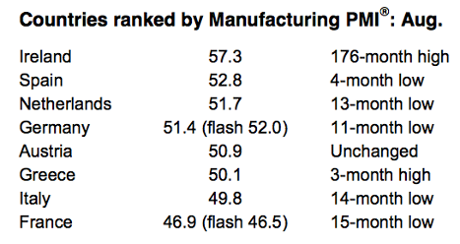
 The overall eurozone PMI, tracking activity across the single currency region, fell to just 50.7 from 51.8 in July, closer to the 50-point of stagnation.
And the number of people employed across the manufacturing sector fell, although it was a mixed picture. The big-three nations of Germany, France and Italy all reported job losses, as did Greece. Staffing rose in Spain, the Netherlands, Austria and Ireland, but Ireland was the only nation to report a faster pace of hiring than in July.
 STUTTGART, Germany — Air Force Maj. Gen. Gregory J. Lengyel assumed command of Europe-based special operations troops on Tuesday, taking over leadership of a force that, after years of focus on Afghanistan, is turning its attention to NATO’s borders.
“When many thought Europe would solely be a producer of world security, events of the past year have validated that this theater of operations still has an appetite to, at times, consume world security,” Lengyel said during a change-of-command ceremony in Stuttgart. Lengyel, who replaced Air Force Maj. Gen. Marshall Webb as head of Special Operations Command Europe, arrives as Europe confronts an array of security challenges that are threatening the post-Cold War order. In Ukraine, Russia’s annexation of the Crimea Peninsula and its continued support of pro-Russian separatists have prompted the U.S. and NATO to re-evaluate their assumptions about security in Europe. NATO members in the eastern Europe are especially worried that an unpredictable Russia could destabilize the broader region. In response, SOCEUR troops have increased missions in the east during the past year, training and exercising with allied special operations forces. At the same time, along NATO’s southern flank there is heightened concern over the Islamic State, a militant group that has seized territory in Iraq and Syria. The fact that many of the group’s fighters come from Europe is raising fear that returning jihadists could carry out attacks at home. Army Lt. Gen. William Garrett III, deputy commander at EUCOM, credited Webb with leading the command’s troops through a period of flux. “During this time he has transformed SOCEUR from a command focused on supporting operations in Afghanistan to a command that can operate in the face of a challenge in dealing with the complex issues across Europe,” Garrett said. While at EUCOM, Webb oversaw the March Navy SEAL operation in the Mediterranean that resulted in the recapture of a hijacked Libyan oil tanker. “One only has to turn on the news to look at what is happening on the borders of EUCOM, in Syria, the eastern flank of Europe, the continuing trouble in north Africa,” Webb said. “This is an uncertain world and we’ve got to be ready. And we are.” Webb will soon assume command of special operations forces at NATO. Lengyel previously served as commandant of cadets at the U.S. Air Force Academy.
Sunday, August 31, 2014
About the European no-union...
 BRUSSELS, August 31 /ITAR-TASS/. Slovakia said it might veto new EU sanctions against Russia, Slovak Prime Minister Robert Fico said after the EU summit on Sunday.
“I believe that the sanctions will become senseless and counter-productive. Slovakia may use its right of veto,” Fico said, explaining Slovakia would use its right of veto if it decided that the new anti-Russian sanctions would undermine its economic growth.
The Slovak prime minister said there was no point in imposing new sanctions until the EU knew the results of the previously adopted penalties. In July, the European Union imposed economic sanctions against Russia over it policy in eastern Ukraine. They include a ban on conclusion of military contracts; restrictions on acquisition of some new technologies, equipment and materials for its oil sector as well as some restrictions on banking services.
Maja Kocijanic, a spokeswoman for the EU high representative for foreign affairs and security policy, said last Friday that the EU Commission was still to analyze the consequences of the EU-imposed anti-Russian sanctions.
The EU summit has given the EU Commission one week to prepare proposals on tougher sanctions against Russia, European Commission President Herman Van Rompuy told a news conference after the EU summit in Brussels. He said the further steps on sanctions would depend on the situation in Ukraine, which was getting worse every day. The EU summit noted the recent escalation of military conflict in Ukraine of which it had been informed by Ukrainian President Pyotr Poroshenko. The European Council voiced its concern with the Russian military presence in Ukrainian territory.
 A large earthquake hit Iceland’s Bardarbunga volcano system early today, but there was no sign of a fresh eruption, the country’s Meteorological Office said.
Authorities have been on alert since a surge of small quakes there this month triggered memories of the 2010 eruption of the Eyjafjallajokull volcano, which spewed out ash and shut down much of Europe’s airspace.
A magnitude 5.4 quake was recorded under Bardarbunga’s main volcano at 0703 GMT, said Icelandic Met Office seismologist Martin Hensch.
It came a day after a small eruption in a fissure in a glacier about 40km from the main crater in Iceland’s largest volcano system.
The Met office initially raised its aviation warning to red, its highest level, on Friday, then reduced it to orange and removed all airspace restrictions after the eruption stopped.
Mr Hensch said there were currently no signs of magma heading back to the surface, though it was impossible to predict how the situation would develop.
“There are so many parameters in this system,” he said. “We cannot make a forecast for the next hours or the next few days. So we have to continue to monitor and react to events when they happen.”
http://rt.com/news/183396-kiev-poroshenko-military-protest/
 Hundreds of people have gathered in front of the Ukrainian Defense Ministry in Kiev, demanding resignation of President Petro Poroshenko and the defense minister over the poor handling of the military operation in the southeast.
The demonstrators, many of whom were mothers and wives of the soldiers involved in the fighting in the Donetsk and Lugansk Regions, have blocked traffic at one of the capital’s arterial roads, the Vozdukhoflotsky Boulevard.
They called on the army to urgently send reinforcements, including tanks and other heavy military vehicles, to the city of Ilovaysk in the Donetsk Region. This strategic town was retaken by the self-defense forces after several days of fighting on Wednesday, which led to the encirclement of a large group of Kiev’s troops.The protesters said that they would remain on the streets until their demands were met by the authorities. Several hours later, the traffic on the Ukrainian capital’s main street, Khreshchatyk, was also paralyzed by demonstrators chanting: “Kiev, rise up!” According to the Itar-Tass news agency, they urged all Kiev residents to join their protest, including recently elected mayor and former boxing world champion Vitaly Klitschko.
The demands at Khreshchatyk were similar – to impeach President Poroshenko and calling for the resignation of the country’s top military officials. The mothers and wives of Ukrainian soldiers also blocked an inter-city highway in the town of Krivoy Rog.
The women said they were in despair as the situation within the Ukrainian military units fighting in the southeast is critical, Channel One reports. “There’s no food, no water, no weapons. There’s lack of personnel,” said a female demonstrator, who was holding a banner that read, “Save our husbands!”
Ukraine has been engulfed in violent internal conflict since April, when Kiev’s military began its crackdown on southeastern regions of the country. The Donetsk and Lugansk regions refused to recognize the new coup-imposed authorities and demanded federalization of the country. According to United Nations’ estimates released Tuesday, over 2,249 people have so far been killed and over 6,033 wounded in the fighting in eastern Ukraine.
The number of internally displaced Ukrainians has reached 190,000, with another 207,000 finding refuge in Russia, the UN said. A group of youths tried to hustle away the soldiers guarding the entrance to the building and make their way into the Defense Ministry, RIA-Novosti news agency reports. But they were asked to stand down by other rally participants, who didn’t want their action to be discredited. The commander of the Donbass battalion, fighting against the militia in southeast Ukraine, Semyon Semyontchenko, has talked to the crowd via a bullhorn, asking the protesters to “show unity.” After several hours outside the Defense Ministry, the demonstrators moved toward the presidential administration building.
Saturday, August 30, 2014
 EU leaders have appointed Italy's Federica Mogherini as EU foreign
policy chief and Poland's Donald Tusk as European Council president. The
announcement came in tweets from the current council president, Herman Van
Rompuy, at an EU summit. Ms Mogherini, a
centre-left politician, is Italy's foreign minister. She will replace the UK's
Catherine Ashton. Mr Tusk, Poland's
centre-right prime minister, has been Polish leader since 2007. He will chair
EU summits. The full-time appointments mean that the EU's three top jobs are
now filled. Mr Tusk and Ms Mogherini will work closely with the new European
Commission President, Jean-Claude Juncker.On arrival at the summit the European
Parliament President Martin Schulz, a Socialist, spoke warmly of Ms Mogherini,
calling himself a "fan". It was a strong indication that she would be
a popular choice among MEPs. The parliament's approval is required for all 28
members of the new Commission, and the EU foreign policy chief, officially
called the High Representative, is also a vice-president of the Commission. Baroness Ashton, a centre-left UK politician,
has been in the job since 2009. The High Representative runs the EU External
Action Service (EEAS). Italy's
centre-left Prime Minister Matteo Renzi pushed hard for Ms Mogherini to get the
job. However, last month the EU failed to get a consensus on her candidacy, as
the Baltic states and Poland saw her as inexperienced and too soft on Russia.
She has only been Italian foreign minister since February.
EU leaders have appointed Italy's Federica Mogherini as EU foreign
policy chief and Poland's Donald Tusk as European Council president. The
announcement came in tweets from the current council president, Herman Van
Rompuy, at an EU summit. Ms Mogherini, a
centre-left politician, is Italy's foreign minister. She will replace the UK's
Catherine Ashton. Mr Tusk, Poland's
centre-right prime minister, has been Polish leader since 2007. He will chair
EU summits. The full-time appointments mean that the EU's three top jobs are
now filled. Mr Tusk and Ms Mogherini will work closely with the new European
Commission President, Jean-Claude Juncker.On arrival at the summit the European
Parliament President Martin Schulz, a Socialist, spoke warmly of Ms Mogherini,
calling himself a "fan". It was a strong indication that she would be
a popular choice among MEPs. The parliament's approval is required for all 28
members of the new Commission, and the EU foreign policy chief, officially
called the High Representative, is also a vice-president of the Commission. Baroness Ashton, a centre-left UK politician,
has been in the job since 2009. The High Representative runs the EU External
Action Service (EEAS). Italy's
centre-left Prime Minister Matteo Renzi pushed hard for Ms Mogherini to get the
job. However, last month the EU failed to get a consensus on her candidacy, as
the Baltic states and Poland saw her as inexperienced and too soft on Russia.
She has only been Italian foreign minister since February.
Subscribe to:
Comments (Atom)