Sunday, January 25, 2015

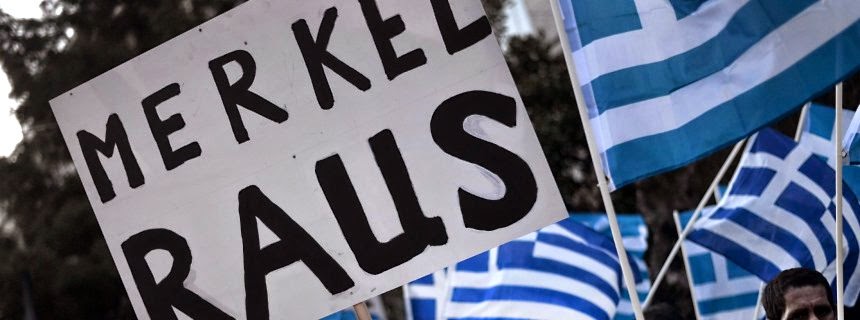
yesss--- perhaps Greece has a chance to get out of this misery called "EU"

Bundesbank president Jens Weidmann has called on Greece to stick to its agreements.  He said he hoped the new government would not make promises the country could not afford, Reuters reports, citing an interview with the broadcaster ARD. “I believe it’s also in the interest of the Greek government to do what is necessary to tackle the structural problems there,” Weidmann said.
He singled out administration, public finances and the economy as being particularly in need of reform.
“I hope the new government won’t call into question what is expected and what has already been achieved,” he said.   Syriza is on track to take 36 and 38 per cent of the national vote, well ahead of Samaras' centre-right New Democracy party which was seen taking 26 to 28 percent, according to an updated exit poll.  The updated poll showed Syriza securing between 148 to 154 seats in the 300-seat parliament. An absolute majority for Syriza will depend in large part on whether former Prime Minister George Papandreou's new centre-left party manages to cross the 3 per cent threshold to enter parliament.    Centrists To Potami and far-right Golden Dawn were tied for third spot with 6 to 7 per cent of the vote, according to the exit poll.
 
The head of Germany’s eurosceptic party Alternative für Deutschland, Bernd Lucke, has called for a haircut for Greece, although he said it must be accompanied with an exit from the euro, according to reports from the Berlin newspaper the Tagesspiegel.
“Syriza doesn’t question the euro, but demands further debt relief and more loans. That doesn’t fit together,” he said.
The chairman of the CDU/CSU group in the European parliament, Herbert Reul, called the idea of another haircut unthinkable. “Greece must continue with the course of reforms if it doesn’t want to risk a departure from the monetary union,” he said.
Pro-Euro, Anti-Austerity: A Perfect Paradox - The irony is that neither SYRIZA nor Podemos are Eurosceptic – at least not openly! Instead, what they represent is a manifestation of popular rejection of Troika-imposed austerity. As Tspiras said in a public address yesterday, “The bailout is over. Blackmail is over. Subservience is over.”
Unfortunately, Tspiras is either badly mistaken or he’s knowingly misleading voters. For as long as Greece is in the euro, subservience will forever be its fate. As I wrote many moons ago, the introduction of the single currency had one primary purpose:
To slowly, almost imperceptibly, weaken nation-state institutions to the point of total dependence on Brussels and Frankfurt; and ultimately have them supplanted with EU institutions. It is the financial equivalent of death by a thousand cuts.
It was ever thus and all by design. As Robert Mundell, the Nobel prize-winning father of the euro, admitted to Greg Palast, the euro is what allows congresses and parliaments to be stripped of all power over monetary and fiscal policy. Bothersome democracy is removed from the economic system as the wholly undemocratic and Goldman-compromised European Central Bank is gifted the reins of economic power. “Without fiscal policy, the only way nations can keep jobs is the competitive reduction of rules on business.”
As such, if SYRIZA genuinely sought to save the Greek people from the Troika’s kiss of economic death, their only option would be a dignified exit from the single currency. Either that or accept the occasional ECB-provided crumb of sustenance (a little shot of QE here and there) and the slight – and no doubt temporary – loosening of the monetary strait jacket. Meanwhile, Brussels’ ever opportunistic elite would no doubt exploit this new crisis to claw its way that little bit closer to its ultimate goal: fiscal and political union. By Don Quijones.
Whatever your opinion of Syriza or Podemos or their respective leaders, Alexis Tspiras and Pablo Iglesias, it is clear that an electoral victory for either party would represent a significant blow against the raggedy status quo. According to Yanis Varoufakis, a university professor of economics hotly tipped to be Syriza’s first ever finance minister, a Syriza government’s first task would be to “destroy the Greek oligarchy system.”
If Syriza wins enough votes to control parliament and its leadership honors its electoral pledges – granted, a massive if! – then perhaps, just perhaps, the country might have a slim chance of getting off rock-bottom as well as setting a more socially inclusive standard of economic governance.
As for those shrieking about Greece’s sacred duty to pay off all its debts, I present Michael Hudson’s mantra of perfect logic:  “Debts that can’t be repaid, won’t be repaid.”
It is the overriding dilemma of our times. As Australian economist Steve Keen says, the only sane and effective response to this dilemma is to ask ourselves “not whether we should or should not repay this debt, but how we are going to go about not repay­ing it.”
If the Syriza bloc does win a landslide victory it will be placed under almost unbearable pressure to toe the Brussels line. The ECB’s choice of timing for its virgin round of Quantitative Easing, just four days before the Greek elections, was surely no coincidence. Nor was the central bank’s decision not to extend its QE program to Greece unless, that is, it concludes the pending Troika review.
As if that were not enough, the ever-dependable U.S. rating agency Standard & Poor’s just issued a statement that it may downgrade the rating of European countries where Eurosceptic parties may assume power. According to the rating agency, the most “credit negative” parties are SYRIZA and Podemos, since they both favor increasing public spending and restructuring their debts.
“Since the onset of the financial crisis, the question of how to unlock new sources of productive employment and strengthen the contribution of economic growth to progress in broad living standards has become an increasingly important concern for political and business leaders in developed and developing countries alike. These challenges have been at the top of the World Economic Forum Global Risks Report survey in recent years”, the paper said...The WEF paper says governments should assess 14 yardsticks of progress under six pillars: education and skills; employment and labour compensation; asset building and business investment; corruption and rents; fiscal transfers; and basic services and infrastructure. Using the tool would allow policy makers to have a clearer sense of how well they were exploiting “available policy space across the full spectrum of levers”.   Samans said the intitial work by the WEF covered 96 rich, middle income and low income countries, and would be refined over the next months. “We are attempting to provide a tool - a rigorous and dispassionate one”, he added. In countries such as the UK, real incomes have been squeezed since the deep recession of 2008-09, with living standards lower than they were at the time of the 2010 election. The WEF said governments should assess whether a “rising tide lifts all boats” by looking at labour’s share of national incomes, whether pay is linked to productivity, minimum wages, trade union density, the scope of collective bargaining and labour-employer cooperation."   Since the onset of the global financial crisis, wealth and income inequalities have accelerated. Hence the rising tide does not lift all boats. Inequalities are constructs which increase social conflict. The rate of environmental destruction is accelerating too. Under-regulated markets fail both people and planet. Time now for fundamental strengthening of above 6 pillars. Hold your politicians to account: how well are they delivering on these 6 pillars of society?

Saturday, January 24, 2015

THE BENEFITS ??? - EU should leave us alone !!!!

Greece has endured deep budget cuts tied to its massive bailout from the so-called troika - the EU, International Monetary Fund (IMF) and European Central Bank (ECB).
The possibility of a Syriza victory in Sunday's vote has sparked fears that Greece could default on its debt and exit from the euro.
THE BENEFITS OF E.U. AND THE EURO
  • Average wage is €600 (£450: $690) a month
  • Unemployment is at 25%, with youth unemployment almost 50%
  • Economy has shrunk by 25% since the start of the eurozone crisis
  • Country's debt is 175% of GDP
  • Borrowed €240bn (£188bn) from the EU, the ECB and the IMF
  •  
    After more than four years of harsh restrictions imposed by the so-called "troika" of the EU, the European Central Bank, and the International Monetary Fund, elections here come just as Greece actually begins to see small signs of recovery. But it is macroeconomic growth that has yet to reach the pockets of ordinary Greeks, who have seen their companies shuttered and their pensions slashed... if Europe is forced to respond to new demands from Greece, it will test cohesion already strained by tensions over NATO and Britain's flirtation with an exit from the EU, says Ian Kearns, director of the policy group European Leadership Network in London. “In that reaction we will see the definition of the European project,” Mr. Kearns says. “It will be the movement of Europe into a new era, one that will lock in austerity or [take] a new path.”   It could also challenge a Greece that has in some ways felt on the mend.  Antonis Birbilis, a volunteer at the electoral stand for New Democracy in Syntagma Square, which was the site of near daily violent protests against austerity, says he fears the election could bring Greece back to darker days.
     
    «Eurozone gloom as French and German industrial output falls». Fear not; the ECB will come to the rescue by letting the Euro devaluate, something it can do for Germany and France, but not for Greece or Portugal.  In the VERY SAME WAY, the obsolete British industry suddenly became «competitive» again when George Soros forced the Pound of the European monetary system in 1992 or 93...European Central Bank staff presented policy makers with models for buying as much as €500bn ($591bn) of investment-grade assets, according to a person who attended a meeting of the Governing Council.  Various quantitative-easing options were shown to governors on January 7 in Frankfurt, including buying only AAA-rated debt or bonds rated at least BBB-, the euro-area central bank official said. Governors took no decision on the design or implementation of any package after the presentation, according to the person and another official who attended the meeting. The people asked not to be identified because the deliberations were private.
    A 500 billion-euro purchase program would take the ECB halfway toward its goal of boosting its balance sheet to avert a deflationary spiral in the euro area. The institution is also buying asset-backed securities and covered bonds, and government bond-buying would be part of fresh stimulus to be considered at the Governing Council’s January 22 meeting.,, And why not? If the Euro devalues it helps all exporters in the EZ. Also Spain, Italy and Greece become cheaper for UK, US and Chinese tourists.

    Friday, January 23, 2015

    The Economist 2015 cover - At first glance, we see political figures like Obama and Putin, references to the Rugby cup and the new Spider-Man movie. But a closer look reveals a plethora of disturbing elements. - The Economist is not a random newspaper that publishes quirky 2015 predictions to sell a few additional copies. It is directly connected to those who shape global policies and who make sure that they are applied. The publication is partly owned by the Rothschild banking family of England and its editor regularly attends Bilderberg meetings. In other words, The Economist is connected to those who have the means and the power to make “predictions” a reality.  The 2015-themed cover basically reflects the overall Agenda of the elite and is peppered with cryptic symbols that appear to be included for “those in the know”. And the masses, like Alice watching the Cheshire Cat disappear, will focus on illusions while the wolf in sheep’s clothing will strike … and strike hard....The presence of the Pied Piper on this 2015-themed cover is downright unsettling. The Pied Piper of Hamelin is a German legend about a man who used his magical flute to lure away the children of the city of Hamelin, never to be seen again....This folkloric figure dating from the Middle-Ages is said to represent either massive death by plague or catastrophe, or a movement of massive immigration. It also perfectly represents today’s youth being “lured” and mystified by the “music” of mass media. Conveniently enough, there’s a small boy right under the Piper’s flute.