Monday, June 13, 2016

Germany’s finance minister, Wolfgang Schäuble, has slammed the door on Britain retaining access to the single market if it votes to the leave the European Union.
In an interview in a Brexit-themed issue of German weekly Der Spiegel, the influential veteran politician ruled out the possibility of the UK following a Swiss or Norwegian model that would allow it to enjoy the benefits of the single market without being an EU member.
“That won’t work,” Schäuble told Der Spiegel. “It would require the country to abide by the rules of a club from which it currently wants to withdraw. If the majority in Britain opts for Brexit, that would be a decision against the single market. In is in. Out is out. One has to respect the sovereignty of the British people.”...Supporters of the British leave campaign argue that it is in Germany’s economic interest to maintain barrier-free trade relations with the United Kingdom. Britain is the third-largest export market for German car manufacturers and the destination of around 7% of total German exports. In a debate on the BBC, Nigel Farage, the Ukip leader, went even further than the official leave campaign and suggested getting rid of tariffs on goods traded with all countries.

Sunday, June 12, 2016

The ASI survey of more than 1,750 adults, carried out by YouGov on June 8, showed that 54pc of Britons would  support Britain pursuing such a deal for five to 10 years immediately following Brexit were the UK to leave. Just 25pc said that they would oppose such an arrangement. Norway, as one member of the four-strong European Free Trade Association (EFTA), is also a part of the European Economic Area (EEA), commonly referred to as the European single market. Sam Bowman, executive director of the ASI, said that a deal that kept the UK in the EEA would “take the risk out of leaving the EU, providing the time it would take to come up with a unique British solution” for trade with the economic bloc.  Experts at the Treasury, the National Institute of Economic and Social Research (Niesr), and the London School of Economics have all found that remaining a part of the EEA would pose the least severe economic risk to  the UK after a decision to split from the EU.  The potential hit to gross domestic product (GDP) from such a move compares favourably with other post-EU options, including a bespoke deal along the lines of that enjoyed by Switzerland, or deciding not to forge a trade agreement at all, and instead relying on the minimum tariff rates secured by the UK’s membership of the World Trade Organization. Other polls show that a large proportion of support for withdrawal is motivated by opposition to EU migration. As such, political experts have suggested that joining up to EFTA, which requires members to allow EU citizens to come and live and work in the UK, could be politically unpalatable.

Saturday, June 11, 2016

Euroscepticism is on the rise across Europe, new research has suggested, with little more than two weeks to go before Britons decide whether to remain within the EU.
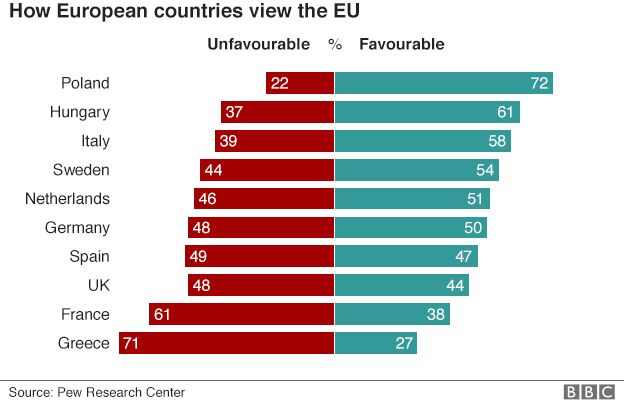
Nonetheless, the Pew Research Center report found that a slim majority - a median of 51% - of respondents across 10 EU countries still favoured the EU.
Forty-two percent want more power returned to their national capitals.
Another poll has found most Europeans want the UK to stay in the EU.
The findings, by TNS (in French), contrasted with its survey among Britons, which found that 41% supported remaining within the 28-member bloc, compared with 43% in favour of leaving.
The UK holds a referendum on 23 June on whether it should stay in the EU or leave.
Graphic
In its poll results released on Tuesday, the Pew Research Center found a majority of people were unfavourable towards the EU in Greece (71%) and France (61%).
That followed a steep decline in EU favourability in France (down 17 percentage points from 2015 to 2016) and Spain (down 16 points over the same period). In the UK, support was down eight points, and in Italy six.
In five of the six nations surveyed in both 2015 and 2016, it found favourability had declined.

Friday, June 10, 2016

Sharapova announced in March she had tested positive for meldonium, insisting she had been prescribed the drug since 2006 for "several health issues", including irregular heart test results and a family history of diabetes.  The 29-year-old also claimed she was unaware meldonium, which boosts blood-flow and can improve endurance, had been added to the World Anti-Doping Agency's banned list from January 1 th Sharapova described the two-year suspension as "unfairly harsh" and says she will lodge an appeal to the Court of Arbitration for Sport.  "While the tribunal concluded correctly that I did not intentionally violate the anti-doping rules, I cannot accept an unfairly harsh two-year suspension," Sharapova wrote on Facebook.  "The tribunal, whose members were selected by the ITF, agreed that I did not do anything intentionally wrong, yet they seek to keep me from playing tennis for two years. "I will immediately appeal the suspension portion of this ruling to CAS, the Court of Arbitration for Sport."
Meldonium was on Wada's watch list last year and in September the agency announced it would be banned from the start of 2016, citing "evidence of its use by athletes with the intention of enhancing performance".  Sharapova's results at the Australian Open, where she lost to Serena Williams in the quarter-finals, as well as her prize money and ranking points earned at the event have also been disqualified.  The Independent Tribunal's report concluded: "The contravention of the anti-doping rules was not intentional as Ms Sharapova did not appreciate that Mildronate contained a substance prohibited from 1 January 2016.  "However she does bear sole responsibility for the contravention, and very significant fault, in failing to take any steps to check whether the continued use of this medicine was permissible. "If she had not concealed her use of Mildronate from the anti-doping authorities, members of her own support team and the doctors whom she consulted, but had sought advice, then the contravention would have been avoided. She is the sole author of her own misfortune."

Thursday, June 9, 2016

The primary elections in the US are nearing the end, and results so far show that Donald  Trump will be the Republicans' candidate, while the Democratic Party seems ready to go all the way to make sure that Hillary Clinton stays in the race for the White House.  But what seemed like a matter of time underwent a major change of the script, as Trump is leading Hillary in the polls. In this case we are talking about the phone calls of the former US state secretary, who violated official regulations and used her own e-mail server during the time that she held one of the most important positions in the Obama administration. After a period of relative calm, when it seemed that Hillary's violation of the law would be eventually overlooked, the situation changed radically over the last few days, after the publication of a report by Office of the General Inspector of the Department of State. It states that the former US State Secretary "used e-mail in an inadequate manner, without complying with the methods for the logging of public documents and without complying with the policy of the ministry", according to an article in the Washington Post. The report explicitly contradicts the numerous statements by the former State Secretary, which states that "the use of a private server was allowed and no official approval was necessary", and Hillary Clinton accused the institution that she used to lead of "anti-Clinton bias".

Wednesday, June 8, 2016

Delegates from Austria, Belgium, Croatia, Czech Republic, Germany, Italy, Montenegro, Netherlands, Spain, Romania and the United Kingdom descended on Barcelona on the 26th of May for the 2nd edition of the Euromat Gaming Summit. The international audience were treated to insights from some of Europe's leading operators as well as a panel discussion with regulators from Spain, Italy, Belgium and the European Commission.  Commenting on the event, Eduardo Antoja, President of Euromat said: "My main conclusion from today's panel discussions is that land-based gaming continues to be the bigger segment of the gaming industry, representing almost 70% of players' expenditure. It will continue to be the first choice for many years provided that regulation keeps pace with technological, social and economic reality. Today Euromat confirmed that it's not just a great representative body for our industry, it's a think tank for our sector". Euromat confirmed that the next edition of the Euromat Gaming Summit will take place in Berlin, Germany in 2017. 

Tuesday, June 7, 2016

The global pensions crisis has been laid bare by new analysis that shows people retiring today can expect half the income of those who became pensioners at the start of the millennium.
The stark findings by the Organisation for Economic Co-operation and Development (OECD) will be presented in a report this week that highlights the impact of ultra-low interest rates on global retirement incomes. It shows that a person buying an annuity today who saved 10pc of their wages into a pension for 40 years can expect just over half the earnings of someone who saved the same amount but retired 15 years ago...The think-tank's analysis of defined contribution schemes, where the value of pension pots can rise or fall depending on how investments perform, highlights the challenge faced by many pension providers in the current low growth and low inflation environment
Pension funds invest around 40pc of their assets in fixed income securities, according to the OECD, including lower yielding government bonds.