Monday, June 16, 2014

VATICAN CITY (Reuters) - Pope Francis sacked the five-man board of the Vatican's financial watchdog on Thursday - all Italians - in the latest move to break with an old guard associated with a murky past under his predecessor. The Vatican said the pope named four experts from Switzerland, Singapore, the United States and Italy to replace them on the board of the Financial Information Authority (AIF), the Holy See's internal regulatory office. The new board includes a woman for the first time. All five outgoing members were Italians who had been expected to serve five-year terms ending in 2016 and were laymen associated with the Vatican's discredited financial old guard. Reformers inside the Vatican had been pushing for the pope, who already has taken a series of steps to clean up Vatican finances, to appoint professionals with an international background to work with Rene Bruelhart, a Swiss lawyer who heads the AIF and who has been pushing for change. Vatican sources said Bruelhart, Liechtenstein's former top anti-money laundering expert, was chafing under the old board and wanted Francis to appoint global professionals like him.
"Bruelhart wanted a board he could work with and it seems the pope has come down on his side and sent the old boy network packing," said a Vatican source familiar with the situation.
The new board of the AIF includes Marc Odendall, who administers and advises philanthropic organisations in Switzerland, and Juan C. Zarate, a Harvard law professor and senior advisor at the Center for Strategic and International Studies, a think tank based in Washington D.C. The other two board members are Joseph Yuvaraj Pillay, former managing director of the Monetary Authority of Singapore and senior advisor to that country's president, and Maria Bianca Farina, the head of two Italian insurance companies.
Francis, who was elected in March 2013 after the resignation of former Pope Benedict, in February set up a new Secretariat for the Economy reporting directly to him and appointed an outsider, Australian Cardinal George Pell, to head it.
In January he removed Cardinal Attilio Nicora, a prelate who played a senior role in Vatican finances for more than a decade, as president of the AIF and replaced him with an archbishop with a track record of reform within the Vatican bureaucracy.
He also replaced four of the five cardinals in the commission that supervises the Vatican's troubled bank, known as the Institute for Works of Religion (IOR).
Since the arrival of Bruelhart in 2012, the AIF has been spearheading reforms to bring the Vatican in line with international standards on financial transparency and money laundering. But Vatican sources say he has encountered resistance from an old, entrenched guard.
A report last December by Moneyval, a monitoring committee of the Council of Europe, said the Vatican had enacted significant reforms but must still exercise more oversight over its bank.
Francis, who has said Vatican finances must be transparent in order for the Church to have credibility, decided against closing the IOR on condition that reforms, including closing accounts by people not entitled to have them, continued.
Only Vatican employees, religious institutions, orders of priests and nuns and Catholic charities are allowed to have accounts at the bank. But investigators have found that a number were being used by outsiders or that legitimate account holders were handling money for third parties.
Monsignor Nunzio Scarano, a former senior Vatican accountant who had close ties to the IOR, is currently on trial accused of plotting to smuggle millions of dollars into Italy from Switzerland in a scheme to help rich friends avoid taxes.
Scarano has also been indicted on separate charges of laundering millions of euros through the IOR. Paolo Cipriani and Massimo Tulli, the IOR's director and deputy director, who resigned last July after Scarano's arrest, have been ordered to stand trial on charges of violating anti-money laundering norms.

Sunday, June 15, 2014

I see that that the EU has pressurised Bulgaria into suspending a new gas pipeline from Russia, paid for by Gazprom, which bypasses Ukraine to supply gas to Europe....
The US is cutting the nose off the face of the EU, we are a rival and we (EU) are being dealt with. The EU is not cutting it's own gas pipelines.
'Bulgaria halts work on gas pipeline after US talk's'...
"Reports on Sunday had quoted Serbian ministers as saying the work was on hold until the EU, Russia and Bulgaria resolved their dispute."
"On Monday, Russia's EU envoy Vladimir Chizhov said the move by Brussels was a "creeping shift to economic sanctions against Russia"."
"It is hard to shake off the feeling that the European Commission's blocking of the start of work on the construction of Bulgaria's key section of South Stream has been done for purely political purposes," Russia's Itar-Tass news agency quoted him as saying."
The only place the US is even mentioned is:
"The EU and the US have imposed sanctions on a number of Russian individuals and companies following Moscow's intervention in Ukraine and its annexing of the Crimean peninsula, but Gazprom has not been targeted."
And even from the link you provided:
"We will decide on further developments following consultations with Brussels," he said after meeting with US senators.
Still, nice attempt at defending your EU friends. Hope your gas supply doesn't go out....
'Prime Minister Plamen Oresharski announced that he had "ordered all work to be stopped".
"We will decide on further developments following consultations with Brussels," he said after meeting with US senators.'

Saturday, June 14, 2014


Iran has sent 2,000 advance troops to Iraq in the past 48 hours to help tackle a jihadist insurgency, a senior Iraqi official has told the Guardian. The confirmation comes as the Iranian president, Hassan Rouhani, said Iran was ready to support Iraq from the mortal threat fast spreading through the country, while the prime minister, Nouri al-Maliki, called on ordinary Iraqis to take up arms in their country's defence. Addressing the nation on Saturday, Maliki said rebels from the the Islamic State of Iraq and the Levant (Isis) have given "an incentive to the army and to Iraqis to act bravely". His call to arms came after reports surfaced that hundreds of young men were flocking to volunteer centres across Baghdad to join the fight against Isis. Rouhani also made reference to the facet Tehran was cooperating with its old enemy Washington to defeat the Sunni insurgent group – which is attempting to ignite a sectarian war beyond Iraq's borders. The Iraqi official said 1,500 basiji forces had crossed the border into the town of Khanaqin, in Diyala province, in central Iraq on Friday, while another 500 had entered the Badra Jassan area in Wasat province overnight. The Guardian confirmed on Friday that Major General Qassem Suleimani, the head of the Iranian Revolutionary Guards elite Quds Force, had arrived in Baghdad to oversee the defence of the capital. There is growing evidence in Baghdad of Shia militias continuing to reorganise, with some heading to the central city of Samarra, 70 miles (110km) north of the capital, to defend two Shia shrines from Sunni jihadist groups surrounding them. The volunteers signing up were responding to a call by Iraq's most revered Shia cleric, the Iranian-born grand ayatollah Ali al-Sistani, to defend their country after Isis seized Mosul and Saddam Hussein's hometown of Tikrit in a lightning advance. Samarra is now the next town in the Islamists' path to Baghdad.
Dear Dave, it was your Tory predecessors that allowed The EU to grab powers from the UK. The first being Heath who did everything to join. Thatcher who instigated and signed The Single European Act and Major who signed the Maastricht Treaty. All transferring a lot of powers to Brussels. All other treaties have been relatively mild and tidying up excerises.


Unfortunately Dave, much as I am not in the Guardian's natural constituency, Juncker appears to be doing precisely what you did in 2010 and for the same reasons - the leader of the largest group should reasonably expect to get the top job. And please don't whine about the price paid for Europe's freedom when in your public pronouncements you wish to distance us from Europe itself, the benefits and stability of those hard-won freedoms, the opportunities and wealth that consolidating those freedoms offers to all European citizens. One might be forgiven for detecting either an essence of complete lack of understanding, a whiff of selective memory, or the stench of pure hypocrisy. For many European citizens the most interesting issue right now is who will win the World Cup. Only a small minority will be following the debate about the presidency of European commission. But this is important because it goes to the heart of the way the EU takes decisions Starting with a patronising generalisation is never a good idea. But at least this time he hasn't gone for beer or bingo as hooks to reel us in.

Friday, June 13, 2014

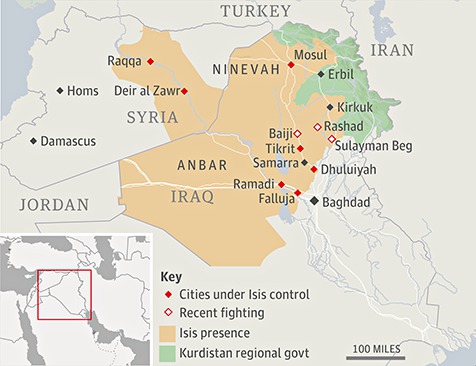
Iraq map locatorThe crisis in Iraq escalated rapidly on Thursday as Iraqi Kurdish forces took control of key military installations in the major oil city of Kirkuk and the Sunni jihadi group Isis revealed its intention to move on Baghdad and cities in the southern Shia heartland.
Kurdish peshmerga fighters entered Kirkuk after the central government's army abandoned its posts in a rapid collapse during which it lost control of much of the country's north.
Iraq has been fragile since the 2003 US-led invasion and the latest developments have raised fears that it is in danger of splintering along ethnic and sectarian lines.
Click here to see a larger version of the map
Iraq has a Shia majority, with a substantial Sunni minority concentrated in Baghdad and the provinces north and west, who have long complained of being disenfranchised. Iraqi Kurds enjoy a large degree of autonomy and self-government in the north-east but have long coveted Kirkuk, a city with huge oil reserves which they regard as their historical capital.
In Kirkuk, truckloads of peshmerga fighters patrolled the streets, but sporadic clashes continued between Kurdish forces and Isis gunmen on the outskirts of the city. A Kurdish minister responsible for regional security forces survived a bomb blast as he drove to the city after visiting peshmerga units in the surrounding region, AFP reported. Since Tuesday, black-clad Isis fighters have seized Iraq's second biggest city, Mosul, and Tikrit, hometown of the former dictator Saddam Hussein, as well as other towns and cities north of Baghdad. They continued their lightning advance on Thursday, moving into towns just an hour's drive from the capital.
About 500,000 people have fled Mosul, home to 2 million, and the surrounding province, many seeking safety in autonomous Kurdistan.
Isis's spokesman, Abu Mohammed al-Adnani, said on Thursday that the group's fighters intended to take the southern cities of Kerbala and Najaf, which hold two of the holiest shrines for Shia Muslims.
US officials have said they are considering ways to help the Iraqi government even as it emerged that the Obama administration had rebuffed a secret request from the Iraqi prime minister, Nouri al-Maliki, to bomb Isis positions.
Reports from Iraq have painted a confused picture of a rapidly developing situation with fighting reported in a number of key locations on Wednesday night and on Thursday, including on the outskirts of the city of Samarra, where government officials said Isis fighters had been driven back.
According to Army Staff Lieutenant General Sabah al-Fatlawi, quoted by Agence France-Presse, "elite forces" backed by air strikes pushed back a "fierce attack by Isis fighters who then bypassed the city heading towards Baghdad".
Complicating the picture of the past few days were emerging suggestions that other Sunni insurgent groups, including Ba'ath nationalists, supporters of the executed Saddam, had played a role in the series of stunning setbacks for the Iraqi military.
The sudden collapse of the Iraqi army has raised international concerns about a rapidly widening regional crisis that has implications for Iraq's powerful neighbours, Iran and Turkey.
Iran's president, Hassan Rouhani, warned in a televised address on Thursday that Iran would combat the "violence and terrorism" of Sunni extremists in Iraq. The foreign minister, Mohammad Javad Zarif, offered Iran's support for Iraq's "fight against terrorism" during a phone call with his Iraqi counterpart, Iranian state TV reported.
In Baghdad residents described panic buying and rising fear.
A meeting of MPs called by Maliki to vote on introducing an emergency law was cancelled after insufficient MPs attended.
The Iraqi leader – a Shia whose authoritarian and sectarian policies have been blamed by many as the root cause of the country's crisis – is trying to hold on to power after indecisive elections in April. The mounting sense of anxiety in the capital followed a statement by a spokesman for Isis who said the group had scores to settle with Maliki's government.
Hundreds of young men crowded in front of the main army recruiting centre in Baghdad on Thursday after authorities urged Iraqis to help battle the insurgents.
The army of the Shia-led government in Baghdad has essentially fled in the face of the onslaught, abandoning buildings and weapons to the fighters who aim to create a strict Sunni caliphate on both sides of the Iraq-Syria border.
In Tikrit, militants have set up military councils to run the towns they captured, residents said. "They came in hundreds to my town and said they are not here for blood or revenge but they seek reforms and to impose justice," said a tribal figure from the town of Alam, north of Tikrit. "They picked a retired general to run the town. 'Our final destination will be Baghdad, the decisive battle will be there,' that's what their leader of the militants group kept repeating."

Thursday, June 12, 2014

At least half a million people are on the move in Iraq after insurgent force the Islamic State of Iraq and Syria (Isis), continued its offensive towards Baghdad, reportedly taking the city of Tikrit – home town of former leader Saddam Hussein – overnight. The assault comes on the heels of Wednesday’s takeover of Mosul and surrounding regions, where a reported 30,000 Iraqi troops fled from just 800 insurgents after three days of sporadic fighting.
In the insurgents' most significant gain so far, Isis fighters entered Mosul and stripped the main army base, released hundreds of prisoners from jails and may have seized up to $480m in cash from Mosul banks. Fighters also seized the Turkish consulate, kidnapping 25 staff including the diplomatic head of the mission.
The swift capitulation of Iraq army forces in the city prompted condemnation and suspicion from the government.
"The army and police and the security organisations are much stronger than they [Isis] are, but there was a trick and a conspiracy," said Iraq's prime minister Nouri al-Maliki. "We will deal with it, but after we end their presence."Tikrit, believed to have been taken by the insurgents overnight, lies less than 200km from capital Baghdad.
In July of last year Isis freed hundreds of convicted terrorists when it overran Baghdad’s Abu Ghraib prison, and in December the group retook parts of former al-Qaida strongholds Fallujah and Ramadi.,,
This is the whirlwind which was sown by Bush, Blair and their Neo-con cronies in 2003, as the civil war in Afghanistan and Pakistan is the result of the failure of their invasion of Afghanistan in 2001. The whole PNAC strategy was doomed to failure from the beginning, and its principal outcome has been to strengthen enormously the hand of Islamists whose fanaticism is the mirror-image of that of the American supremacists.
One can only feel the most profound pity for the millions of innocent civilians whose fates are now in the hands of brutal forces unleashed as a result of our meddling.