Monday, October 27, 2014

Europe was alight with speculation on Friday about verdicts on the financial health of the region’s 130 largest lenders.
The big question was - and, well 25 failed -  which banks might fail the central bank’s review and how much new capital might be needed for the banks to survive. Estimates of the capital shortfall varied widely, from about 10 billion euros, or about $12.6 billion, to as much as €50 billion. The central bank’s review was based on figures at the end of 2013. Banks that have not passed muster and have not taken steps to shore up their finances will have nine months to top up their reserves. Otherwise, they risk being shut down. The central bank noted the results would not be final until approved by its governing council Sunday morning. “Until that time, any media reports on the outcome of the tests are by their nature highly speculative,” it said. Banks were informed of the preliminary results of the review and stress tests on Thursday. They will not know for sure whether they passed or failed until Sunday, shortly before the public disclosure. Most analysts expected the shortfall to be relatively modest, in part because bankers have known for a year that the test was coming and have sold risky assets and raised more capital, money that is available to absorb losses and is crucial to a bank’s survival in a crisis. “The number of banks that would need to raise additional capital will be limited,” analysts at Barclays said in a note to clients on Friday. “This is due to the substantial pre-emptive measures that the banks have already undertaken.” Betting on which banks would do better or worse than expected was rampant on Friday. Trading was suspended on Friday in shares of the Italian bank Monte dei Paschi di Siena after they jumped more than 10 percent on the strength of speculation that it would fare better than expected under European Central Bank scrutiny. The larger question is whether the review, which included an audit of bank holdings followed by so-called stress tests of their ability to withstand a crisis, will remove doubts about the underlying health of eurozone lenders and make it easier for them to raise money that they can lend to customers.
Jörg Krämer, chief economist at Commerzbank in Frankfurt, was pessimistic about the effect that the review would have on the eurozone economy. The reason for declining credit in the eurozone is not that banks cannot lend, he said on Friday, but that businesses do not want to borrow. “The stress tests will help certain countries like Italy and Spain,” Mr. Krämer said in a meeting with a small group of journalists. “But it won’t be a breakthrough for the whole eurozone.” There could be a sell-off in financial markets on Monday if the central bank uncovers a bigger capital gap than expected. But there is also a risk of a negative market reaction if the review appears to be too lax. Previous stress tests by other regulators gave stamps of approval to banks that later failed, undermining trust in the whole banking system. The European Central Bank has a strong incentive to be tough. It will become the overall supervisor of eurozone banks on Nov. 4, and needs to show it has the skills and backbone to do the job. “If convincing enough, the assessment can support sentiment, the eurozone economy and the banks,” Suvi Kosonen, an analyst at ING Bank, said in a note on Friday.
The central bank conducted the stress tests with the European Banking Authority, which will simultaneously release results on Sunday that include lenders in European Union countries that are not in the eurozone, like Britain and Sweden. Banks found short of capital will have two weeks to submit a plan to the central bank on how they will shore up their finances. Even banks that pass could find themselves under pressure to raise more capital, if they pass only narrowly. The audit will expose that banks may have been overvaluing their assets or failing to set aside enough money to cover bad loans.(source NYT)

Sunday, October 26, 2014

Two mafia bosses - incompetent and corrupt - leaving the EU stage - thank's god !!!

BRUSSELS (EUObserver) - Herman Van Rompuy and Jose Manuel Barroso said goodbye to EU leaders on Friday (24 October) after attending their final summit as presidents of the EU council and commission.  For the Belgian Van Rompuy it marks almost the end of an almost 5-year term in which he worked behind the scenes to keep the EU united as it went through its deepest-ever economic crisis and tried to find solutions from preventing it ever happening again.  He was the first ever permanent president of the European Council, meaning the poetry-writing politician got to define the parameters of the job, making it a chairman rather than presidential post and preferring to be low-key.  "Politics is a rough trade" he noted but said he had been given loyalty and respect by colleagues. "I am leaving with the feeling that I have done all that I could." He recalled the bitter negotiations on the EU's longterm budget as requiring the most political skill and, like Barroso, remembered the pride of collecting the EU's Nobel peace prize. "Not only is my mandate coming to a close but so is my political and public life which has filled a large part of my life," said Van Rompuy, who formally steps down on 30 November.  He added, in his typical style, "in my life I have never had the feeling of being irreplaceable. There was a European Council before me. There will be a European Council without me." Barroso, whose term finishes next Friday (31 October), noted that he had attended 75 EU leader summits since he became commission president ten years ago. He said that how the EU had evolved over the years made him optimistic about its future, and spoke of "great" and "very difficult" moments over the past decade.  The Portuguese politician, who was generally regarded as reactive rather than visionary president, spoke for longer at the final press conference than Van Rompuy and mentioned that he had gathered his "testimonies" which could be downloaded "for free". An earlier ceremony among leaders saw the two leaders given porcelain plates as gifts a long with a signed 'family photo' of all the leaders.  Van Rompuy's plate was inscribed with one of his Haikus (Japanese poetry form) about Europe, written in his native Dutch; Barroso a plate with his motto "Let's build Europe together".  German Chancellor Angela Merkel gave a little speech on behalf of everyone. She was chosen, she said, because she was now the longest-serving EU leader.  She said Barroso worked as a lynchpin between the EU main institutions and reminded member states of the rules "whether we liked it or not" and said leaders would "miss" having Van Rompuy at the helm. While it was the two politicians' last summit, the meeting is most likely to be remembered for a row with Britain over it having to pay an extra €2bn towards the EU.  Prime Minister David Cameron, in a podium-banging press conference, said he would not pay it by the 1 December deadline.  The dispute escalated because it was initially unclear how the figures were arrived at. Barroso spent much of his final press conference as EU commission president going through the finer details of EU budget calculations for member states.
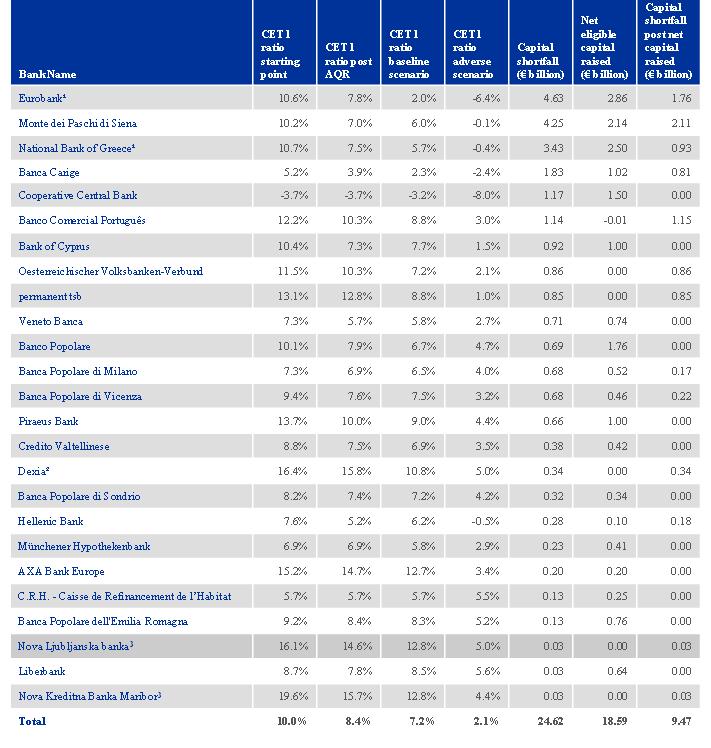
European banking regulators warned on Sunday that 24 banks in the European Union had a €25bn (£19.6bn) capital hole after being tested over their financial strength. The outcome puts the focus on Italian banks, nine of which were found to have a total shortfall of €9.4bn, the largest of which was at Banca Monte del Pashi di Siena. In Greece, three banks failed the stress tests, with the same number failing in Cyprus. The European Banking Authority (EBA) also found that a number of banks were close to failing the tests, which examined whether they had enough capital to withstand a series of economic shocks, such as a rise in unemployment and declining economic growth. UK banks passed the tests but Ireland’s Permanent TSB failed. The banks being tested had combined assets of €28tn – 70% of assets in the EU. Twenty-six of them, including the Royal Bank of Scotland and Lloyds Banking Group, had their restructuring plans approved before the tests started. The banks now have two weeks to tell the European Central Bank how they intend to plug the gaps in their balance sheets. Their financial strength was tested at the end of 2013, along with their likely position at the end of 2016 after being subjected to market and economic shocks.
 
I've been of the opinion, for quite some time now, that a massive public works program is what is needed as the next form of economic stimulus both here and abroad. The Obama administration did purpose a public works program at the onset but it wasn't big enough and it was fraught with cronyism and corruption. When coupled with an unprecedented quantitative easing program it was just enough to pull us back from the precipice by our coat tails, barely .... What harm could possibly come from renewing our ageing infrastructure? Financing such endeavors with debt is a win win situation. It's good for the institutional bondholders and hedge funds that purchase the notes in the end because they make a profit, and it's good for the workers that are employed for the duration of the projects. And it's good for the services sector because it lowers operational costs due to improved infrastructure going forward. There's even the possibility of improving tax receipts and certainly cash flow for the governments that choose this path. Which could lead to retiring the bonds early and juicing growth rates overall for the foreseeable future. Of course addressing inequality is a prerequisite for sustained economic growth. You just can't have piles of money sitting around in a vault somewhere and expect economic growth, it must be spent.

Saturday, October 25, 2014

Clearly, the IMF and the World Bank have begun to realize that the system is broken. Unfortunately, no-one seems to have a clue what to do - apart from yet more QE and praying that the Banks will start lending. Have they not realized that the real problem lies in the way money is created in the system? As Positive Money have been arguing very coherently for some years, 97% of the money in the economy is currently created out of thin air when Commercial Banks make loans in the form of interest bearing debts. Even the Bank of England has now come clean on this mind boggling fact. Yes, Mr Cameron, there is a magic money tree. There's one in every Bank in the world. That's how our current money system works.
The interest payments generated by this insane debt-based money system are absolutely crippling the entire world economy. 3% of all GDP is currently being used to pay the interest payments on government debt, and in the 28 EU countries, those unjustifiable interest payments have cost taxpayers a total of over €6.2 trillion since 1996 - 54.8% of all government debt. And that is despite the fact that the banks who lend their "money" to governments don't even have the money they lend. What's even more stupid is that since the Basel regulations say that lending to AAA to AA- rating sovereigns has a risk weighting of zero - they don't even need any capital to make the loans. The result is that commercial banks can have thousands of times more assets than capital.
And 3% of GDP is just what tax payers end up paying to the banking system to cover government debt. Add in the interest payments on all the household and business debt and you can see that the entire system is currently set up to transfer the maximum amount of wealth from the people and businesses that do the work, to the people who control the money creation process - namely, commercial banks.
The overall consquence of this insanity is that there is currently about twice as much debt in the world economy as there is money. In other words, there is simply no way to pay of the debt. Osborne's austerity and more bank generated debt can only make things even worse. The system has to change. One simple option is for Central Banks to impose a modest financial transaction tax on all electronic transactions denominated in their currency - wherever they occur in the world. The revenue generated should be reinjected into the real economy as debt free money, either by simply giving the money to governments debt free, or by making direct payments to citizens in the form of an unconditional basic income.
Within a few years, this mechanism would allow the current mountain of debt to be converted progressively into debt free money that can circulate freely within the economy. Taxing financial transactions would also be a very intelligent alternative to the current totally obsolete tax system. With global financial transactions in 2013 running at at least $10 quadrillion a year, even a tax rate of less than 0.1% would easily allow taxes like VAT, Income Tax, or Corporation tax to be scrapped, providing a massive boost to the real economy. There is really no excuse for the IMF and the World Bank to do nothing.

Friday, October 24, 2014

Moscow will reduce gas supplies if Kiev starts siphoning deliveries destined for Europe, said Russia’s President Vladimir Putin during a visit to Serbia. “There are large transit risks. If we see that our Ukrainian partners start illegally taking our gas from the export pipeline as it was in 2008, we will equally reduce the amount of supply as happened in 2008,” warned Putin on Thursday at a news conference in Belgrade, stressing he was "hopeful" it would not come to that. However, the Russian president pledged that Moscow will supply enough gas to Europe this winter.
"I can tell you for sure, and I am saying with absolute responsibility, there will be no crisis in Europe due to the fault of Russian participants in energy cooperation," Putin stressed.
"Russia has always been a reliable supplier, we have enough resources."  Given the threat of gas disruption, the South Stream project starts looking increasingly attractive and “beneficial for European consumers,” Putin said. The issues connected with the delay of the construction of South Stream are “of a political character” only, he added. “In this case politics hurt the economy for sure, causing damage to a certain extent, even reducing the competitive advantages of the European economy in comparison with other regions of the world.”  Putin requested support from his European partners, saying Russia couldn’t “unilaterally construct a pipeline system worth billions of dollars if our partners are still thinking whether to develop the project or not."
The Russian leader said there was a big debate during the construction of the Nord Stream pipeline along the bottom of the Baltic Sea. However now, when the project is finished, “everyone is happy and saying ‘thank you’,” as the pipeline “turned out to be very helpful,” he added. The South Stream gas pipeline is a transport grid that will deliver gas to South and Central Europe via the Black Sea and the Balkans instead of through unreliable Ukraine. The project started in 2002, with first deliveries due in 2016, and it is expected to be fully operational in 2018.

Thursday, October 23, 2014

Capitalism barely exists nowadays. Capitalism means privatised profits, and privatised losses. Not, privatised profits, and socialised losses. Eg - Where businesses take the profit during the good years, and then get bailed out by the tax payer during the bad times. Businesses are nothing more than people. The people aren';t to blame for this mess. Its the governenment meddling - low interest rates, bailing out banks, excessive debt fuelled state spending etc that have led to the mess we are in....World leadership through this crisis has been an utter failure. Especially from Germany which everyone fell supine before and begged for their help. They responded not with solidarity buy with the punishing diktat of austerity based not on economic analysis but on religious (Calvinist) ideology. (If you think that statement is off, go and read the speeches given by the German finance minister which are full of moralizing and void of economic analysis) Punish the offenders such as Spain obviously so irresponsible they actually had a surplus when the crisis hit. The West is in the powerful grip of Neoliberal ideology which is the reason for the extreme inequity and widespread economic suffering of tens of millions of people. That is what must change....The leaders of the Eurozone are mired in a political swamp of their own making and there appears to be no end in sight. Even those opposed to further EU expansion agree that to make the Eurozone work you need a fiscal union but politically that seems as far away as ever. The other option is to break up the Eurozone with individual country's choosing to leave, and at present this seems the more likely course of action of the two. In Italy the five star movement have now decided to campaign to leave the Euro, FN in France is anti-euro and in Germany the AFD is a growing political force.