Tuesday, June 23, 2015

Greece’s international creditors are aiming to strike a deal to stop Athens defaulting on its debt and possibly tumbling out of the euro by extending its bailout by six months and supplying up to €18bn (£12.9bn) in rescue funds.  The Brussels-based negotiating team are also proposing to pledge debt relief for the austerity-battered country – but officials stressed that a breakthrough hinged on a positive response from the Greek prime minister, Alexis Tsipras.  Negotiations were continuing on Sunday night, hours ahead of crucial gatherings of eurozone finance minsters and leaders in Brussels, which Angela Merkel, the German chancellor, François Hollande, the French president, and Tsipras are expected to attend. All three leaders spoke over the weekend, with contributions from European commission head Jean-Claude Juncker.  The crisis meeting was convened in an attempt to ease Greece’s debt crisis before a critical €1.6bn payment to the International Monetary Fund falls due next Tuesday. 
Reuters reported on Sunday that €1bn worth of withdrawal orders had been lodged with Greek banks over the weekend – on top of the €4bn that left the country’s banking system last week. The news agency also said that the European Central Bank was set to discuss extending financial help to the banks this morning, amid fears that Greek banks would be unable to open on Tuesday.
A hectic round of telephone diplomacy took place over the weekend between leaders in Athens, Berlin, Paris and Brussels while technocrats on both sides sought to hammer out the small print of the fiscal arithmetic forming the basis for a last-minute agreement days before Greece’s existing bailout expires.  With time running out, the only way an IMF default could now be avoided is for the ECB to raise the ceiling on the short-term debt Athens is allowed to sell, the officials said. This would need to happen by Monday next week. Brussels sources also signaled moves to address Tsipras’s key demand – that the creditors need to offer debt relief to Greece.  Some form of debt restructuring would be promised to Athens in the future, but it would come with strings attached and not as part of the current bailout package, they said.  Yanis Varoufakis, the outspoken Greek finance minister, said on Sunday that Greece’s fate hinged on Merkel, and told her she faced a stark decision. But his spokesman reacted sceptically to suggestions of creditor promises on eventual debt relief, describing the eurozone as “pathological liars”.

Monday, June 22, 2015

EU council chief Donald Tusk has left his meeting with Mr Tsipras and given a short statement to reporters.  Here's what he had to say: "I have called this summit because time is running out, not only for Greece but all of us. We only have one week before the current programme expires. This means the lets-wait-and-see strategy must end.  "It is my responsibility to ensure we respect all taxpayers in all a countries. If they hadn't borne the burden of austerity, they wouldn't be able to help Greece today.  " I am absolutely convinced that the blame game leads nowhere. I want all cards on the table. This doesn't mean negotiating technical details, but to end the political gambling. Since I called this informal meeting, some promising things have happened, including today's talks. And the latest Greek prosposals are the first real proposals in many weeks, although they still need an assessment from the institutions.  "We must avoid the worst case scenario, which means an incontrollable, chaotic Greixdent." ...George Saravelos of Deutsche Bank highlights that the only thing keeping Greece in the euro is the ECB.   The central bank moved to raise its ceiling on emergency funds today by a further €1.3bn as the country is in the throes of a bank run. Saravelos now thinks the ECB will now be called upon every day to hike its liquidity limit to prevent a banking collapse. But, in order for that to happen, European leaders need to provide some positive signs out of tonight's series of meetings.  Some insights:  Written acknowledgment of progress is likely to be required to maintain ongoing ECB financing of Greek banks, with the central bank approving an additional increase in ELA provision to the Greek banking system this morning given accelerating deposit outflows. Given the scale of deposit outflows and ECB discomfort with rising exposure, ELA approval is likely to take place on a daily basis over the course of the week depending on the evolution of talks.  If progress is achieved over the course of the day, the Euro leaders summit is likely to open discussions for post-programme arrangements, though press reports that a parallel discussion around a "plan B" of a breakdown in talks is also possible.  The Euro leaders summit is likely to address some of the parameters for a third programme, inclusive of the potential for debt relief. We would expect a re-affirmation of the November Eurogroup 2012 commitments on the latter to be the most likely outcome.  Nothing is likely to be finalized unless a full staff-level agreement has been reached between Greece and its creditors over the next few days. There will be a second (and likely last) opportunity for Greece to be discussed at the Euro-area leaders level in Thursday/Friday’s EU leaders’ summit.

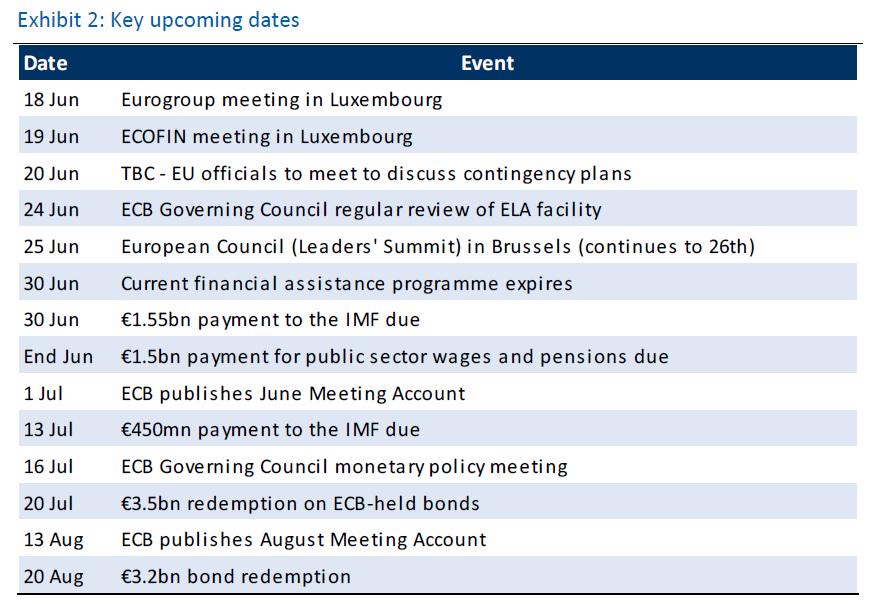
The key dates for Greece over the next 2 months, via RBC

Embedded image permalink    

Sunday, June 21, 2015

The banks were not allowed to fail. Greece is not allowed to fail. In our classrooms the children are not allowed to fail. Failure is a necessary part of life. It is essential if capitalism to succeed.
The lenders should not have provided the money and the Greeks should not have borrowed so heavily. Both should lose.Visitors to the Greek islands this year might conceivably begin their holidays with euros in their wallets and go home with drachmas. In between might come a tumultuous period when capital controls lead the cash machines to run dry – and the government suspends all movement in and out of the country.  Travel agents have sought to play down any concerns and reassure British holidaymakers. A spokesman for Thomas Cook said that all contingency plans were in place, adding: “We’re prepared for any scenario."   The Association of British Travel Agents (ABTA) said there was no need for anyone presently heading for Greece to rebook for another destination. “Any switch to a new currency would take time and Euros would likely be accepted in the interim,” said a statement from ABTA. “This is an unusual situation - but the industry is experienced in handling unusual situations.”  The one piece of advice is that travelers should take enough cash in euros to last for their entire holiday – just in case the banks collapse halfway through a summer break.  Meanwhile, frantic efforts are underway to secure a deal between Greece and its creditors before the IMF payment falls due in 10 days’ time. The aim of the talks is to release enough of the €7.2 billion (£5.1 billion) in Greece’s existing bailout fund to allow the country to avoid a default. Popular support for the euro is creaking as the economy is thrown back into turmoil.  More than 210,000 Greek families have applied for meal coupons and free electricity since Syriza launched a humanitarian aid programme in April.  The jobless rate is also creeping up. Over one out of every four Greeks remain out of work.  Of the hordes of unemployed, over 70pc have been without a job for over a year. Athens and its environs hold the ignominious title of the long-term unemployment capital of Europe - worse than the poorest parts of rural Slovakia and Latvia.
Nominal GDP is now set shrink to its lowest level since 2003 this year, the riches of its early euro boom years all but wiped out. It is the deepest depression suffered by any developed economy in the modern era - eclipsing that witnessed in 1930's America.
FINLAND - Faced with a bloated state, below-par growth, and prices and costs that have risen at a much faster pace than the rest of the eurozone, the medicine is a familiar one.  "The key to resolving the serious problems in the economy lies in structural reforms, fiscal consolidation and improved cost competitiveness," the Bank of Finland's latest health check of the economy said last week.
The phrase could have been taken from Greece's own long austerity prescription, but with an ageing population, state spending approaching 60pc of gross domestic product (GDP) and tax revenues far short of this, something has to change, and quickly. Finland, which has become known as one of the eurozone's lead preachers of fiscal prudence, will embark on a €10bn (£7.2bn) round of belt tightening over five years. Well, Finland and Estonia are economically (and culturally) closely wed, Greece and Cyprus like.  Finland and Russia. Well Finland is the only EU member nation to border Russia and not be a NATO member. I suspect they are wary of Russia but have a greater understanding of Russia's somewhat justified paranoia and anger with broken ' influence space' NATO invasions since the 1990's. They seek the old USSR relationship probably which worked well for Finland. Your last sentence captures this. BTW by many polls the most pro-EU Nordic - not members yet (and they were in the list with Denmark, UK and Ireland in the 1960's - is Norway.  Following April's elections, Juha Sipila, the prime minister, Timo Soini, the eurosceptic foreign minister and Alexander Stubb, the finance minister, have pledged to create more jobs, to get the economy moving and avoid a "lost decade" from a lack of reforms.   Finland is out on its own compared to the other Nordic countries in joining the Euro. Norway isn't even in the EU, Sweden has done well keeping the Krona and Denmark has kept their Krona but ties it to the Euro, a tie that could easily be broken if the proverbial hits the fan. Finland is looking rather isolated. Of course the Baltic states are in the Euro but they have all paid a heavy price for membership.  Would I be right in thinking that Finland is being hurt by Russian retaliatory sanctions rather more than other countries? Whilst they must have an historical healthy fear of Russia, I would imagine they are far more scared about the West restarting the Cold war in extreme earnest because of western interference in the internal affairs of Ukraine.

Saturday, June 20, 2015

The European Commission has approved a financial contribution of 83 million Euros from the Cohesion fund to the major project "The expansion of the Subway line no. 4, the Parc Bazilescu - Străuleşti section", which is part of the Operational transport program, according to a press release by the European institution.  The objective of the project is the expansion of the line 4 of Bucharest with a new segment of almost 1.89 km and the construction of two new subway stations along this new segment.  The new segment will cut the travel time by approximately 65% along the lane that corresponds to subway line four and will be used by an estimated 3,638,700 passengers/year. The total value of the project is 97,761,634 Euros.  Regional policies commissioner Corina Creţu said: "The main beneficiaries of the new infrastructure will be the almost 50,000 residents of the Bucureştii Noi and Chitila neighborhoods, which will get direct access to the subway system. The population in north-western Bucharest and that of the cities of Mogoşoaia, Buftea and Chitila will also benefit from easier access to the high capacity transport network". According to Metrorex officials, quoted by Agerpres, commissioning Trunk 4 will lead to higher overall attractiveness of the subway grid and implicitly, this will reduce the workload of surface transportation, which will lead to lower pollution, fewer accidents, less road degradation and last but not least, shorter travel times.  The Cohesion Fund is destined to the member states whose revenue per capita is below 90% of the EU average. This is intended to reduce economic and social inequalities and the promotion of durable development.

Friday, June 19, 2015

Greece’s creditors on Thursday issued their starkest warnings to Athens since the start of a five-month stand-off over the country’s soon-to-expire €172bn bailout,  with the International Monetary Fund withdrawing its negotiating team and European leaders saying the time for compromise had ended.   In a series of meeting in Brussels, Mr Tsipras was told his cash-strapped government must quickly decide whether to accede to more economic reforms or face bankruptcy. “We need decisions, not negotiations, now. It’s my opinion that the Greek government has to be, I think, a little more realistic,” said Donald Tusk, the European Council president, who met Mr Tsipras privately on Wednesday.  “There’s no more space for gambling, there’s no more time for gambling. The day is coming, I’m afraid, where someone says the game is over.”
So it appears things are far more serious than the Telegraph is reporting, they are almost at a time when they will be offered a simple take it or leave it situation, with the ECB printing press already fired up I believe enough has already been done to minimise any damage a Grexit may have caused in the past...Varoufakis understands very well the type of individuals he is having to deal with from IMF, and I can assure you he will not give them an inch.  He understands 'precisely' how nations such as Greece have ended up as heavily endebted as they have. I mean, it is not as if they are on their own for gods sake.  Almost every nation on the face of planet earth is now in the same boat, so you cannot say that it has occurred by chance.  In fact, going by the terrible state of the entire global financial system, one can only come to the inevitable conclusion that the situation we now find ourselves in was created on purpose.  A system designed to benefit 'the few', at the expense of the many. I say "go on Greece, blow this stinking ship clean out of the water".  Financially cripple the elites, do us all a big favor.