Wednesday, January 6, 2016

Spain's left-wing Podemos (We Can) party has refused to join any coalition led by the centre-right Popular Party (PP), which won the 20 December election but fell short of a majority.
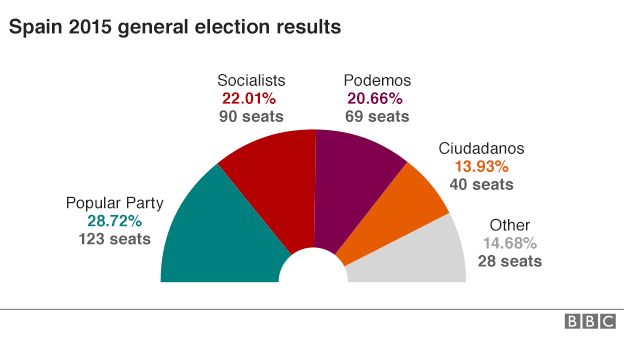
Podemos was launched nearly two years ago, based on mass anti-austerity protests. It came third, with 69 seats. Podemos leader Pablo Iglesias rebuffed the PP leader and acting Prime Minister Mariano Rajoy, as did the Socialist (PSOE) leader Pedro Sanchez last week.  New elections might have to be held. The PP came top with 123 seats in the 350-seat lower house of parliament - far short of a majority. In second place was the PSOE with 90, and the new liberal Ciudadanos (Citizens) party was fourth with 40.   Speaking after talks with Mr Rajoy, Mr Iglesias his priority was "social emergency" legislation to help families threatened with eviction and other socially vulnerable groups, such as poor pensioners.  He refused to support Mr Rajoy "whether actively or passively" - ruling out a coalition partnership or abstention in a confidence vote.
Spain results graphic

Ciudadanos leader Albert Rivera also told Mr Rajoy he would not back him. But Ciudadanos would abstain in the confidence vote if Mr Rajoy managed to put together a coalition, he said.
The PSOE says it will only consider a leftist coalition with Podemos if the latter drops its support for an independence referendum in Catalonia.  Many Catalans want such a referendum, but Podemos is the only one of Spain's major parties to back the idea.  Mr Sanchez called on Podemos to "renounce any position that implies the rupture of co-existence between Spaniards". Next month King Felipe VI will seek to nominate a party leader for government, but that leader must then win a vote of confidence in parliament. If there is deadlock two months after that the king will call a fresh election.

Tuesday, January 5, 2016

The people that run the EU will not allow it to fail.  Look at Greece. The first real chance to stick two fingers up to Brussels, but ultimately, the Greek politicians bottled it under threats and blackmail from the EU.  The same will happen in Spain.  The Front National was shafted in France by a combination of the two major parties in France fixing the electoral system and the EU scaremongering the French public.  Cameron has not bottled it, because he has never tried to stand up to the EU in the first place.  The EU will prevail.  At the first sign of any serious unrest, pressure will be applied behind the scenes on the respective government to send troops onto the streets to restore order if necessary.  The genie is out of the lamp and there is nothing we can do about it short of armed insurrection...The Traverling Circus of the EU  Parliment.
(1) The most outlandish of the European Union’s excesses; a £130 million travelling circus that once a month sees the European Parliament decamp from  Belgium to France.
Over the course of the weekend, some 2,500 plastic trunks will be loaded on to five lorries and driven almost 300 miles from Brussels to Strasbourg. In all, the EU admits that the monthly Strasbourg sitting, which lasts just four days, costs an additional £93 million a year. The Conservative Party in Europe, which is leading a campaign to abandon it, estimates the cost a little higher at £130 million, or about £928 million in the seven-year cycle of an EU budget.
(2) Treasury figures have shown that the annual cost of a MEP sitting in the EU
assembly is £1.79 million each a year, which is three times the cost of a Member of Parliament in the House of Commons. The European Parliament, with 766 MEPs, cost £1.3 billion in 2012 – expenditure that was shared across the EU's members with a share of the annual bill for British taxpayers of £170 million. In contrast, the combined cost of the House of Commons and House of Lords, with 650 MPs and around 720 active peers, was £494 million in the same period.
Part of the difference is salary: MEPs are considerably more highly paid than MPs, with a £80,000 per year, paid with low 23 per cent "community tax rates", compared with £66,396 for elected representatives in the Commons.  But the big difference between MEPs and MPs is the generous, or even lavish, expenses and allowances – entitlements that are worth over £415,000 a year each. One allowance for parliamentary assistants to work in the Brussels or local office of an MEP is worth £213,000 a year.
(3) The European Union is accused of “breathtaking hypocrisy” for continuing to demand that David Cameron pays a £1.7 billion bill despite its own auditors failing to give a clean bill of health to more than £100 billion of spending by Brussels.  According to the annual report of the European Court of Auditors, seen by The Telegraph, £5.5 billion of the EU budget last year was misspent because of
controls on spending that were deemed to be only “partially effective” by experts.  The audit,published this morning, found that £109 billion out of a total of £117 billion spent by the EU in 2013 was "affected by material error”.It means that the Brussels accounts have not been given the all clear for 19 years running.
(4) What right has Brussels got to spend our taxes on feed us Lies on why we should stay in this broken EU, which does not serve the common person in the streets of the UK.  Voters face being bombarded with pro-Europe propaganda in the months leading up to the referendum as there is no limit on how much Brussels can spend on efforts to keep Britain in the European Union, campaigners have warned. The European Commission has formed a task force in Brussels to oversee an
“information” campaign in the run-up to the in/out referendum, which is expected
to be held next year.

Monday, January 4, 2016

Bail ins are coming. ALL major banks are technically insolvent as they have exposure to derivatives and cds than actual assets- if they were normal businesses they would be allowed or forced to fold. All taxpayers are still technically on the hook, previously a government would foot the bill and pass on the cost, now it's depositors actual money at risk, money which in law is a credit to the bank, not legally owned by the depositor- the account holder. Many derivatives contracts are linked to oil prices or interest rates and as the worldwide economy is tanking, and there is plenty of evidence for this, these contracts WILL take down some big players. JPMorgan, citi, BoA, Deutsch bank, and many others use off book accounting to hide their actual liabilities and the whole cabal is fraudulent on an unbelievable scale. When confidence in the system falls, it will collapse and trillions in wealth will be confiscated.
The global monetary system was designed by bankers for bankers and they get a cut at every step in the process.
They are given the privilege of creating money out of thin air (fractional reserve banking), which they can then lend out and charge interest on.
There is only one task they have to carry out and that is to lend the money prudently to people that can pay them back plus the interest.
Could it be any easier, with no manufacturing, supply and distribution chains to worry about?
What are bankers like at prudent lending?
“What is wrong with lending more money into the Chinese stock market?” Chinese banker recently
“What is wrong with lending more money into real estate?” Chinese banker last year
“What is wrong with lending more money to Greece?” European banker pre-2010
“What is wrong with a NINA (no income no asset) mortgage?” US banker pre-2008
“What is wrong with lending more money into real estate?” US banker pre-2008
“What is wrong with lending more money into real estate?” Irish banker pre-2008
“What is wrong with lending more money into real estate?” Spanish banker pre-2008
“What is wrong with lending more money into real estate?” Japanese banker pre-1989
“What is wrong with lending more money into real estate?” UK banker pre-1989
“What is wrong with lending more money into the US stock market?” US banker pre-1929
Globally incompetent at the only job they have to do.
Shouldn’t we be asking why bankers are so useless rather than bailing them out?

Sunday, January 3, 2016

It’s an idea whose adherents over the centuries have ranged from socialists to libertarians to far-right mavericks. It was first proposed by Thomas Paine in his 1797 pamphlet, Agrarian Justice, as a system in which at the “age of majority” everyone would receive an equal capital grant, a “basic income” handed over by the state to each and all, no questions asked, to do with what they wanted.
■ A “basic income”, first proposed by Thomas Paine is an income unconditionally granted to all on an individual basis, without any means test or requirement to work.
■ It is paid irrespective of any income from other sources.
■ It is paid without requiring the performance of any work or the willingness to accept a job.
■ Advocates say it will allow people to genuinely choose what sort of employment they take, and to retrain when they wish.
■ Its proponents also claim that a basic income scheme is one of the most simple benefits models, and will reduce all the bureaucracy surrounding the welfare state, making it less complex and much cheaper to administer.

Saturday, January 2, 2016

The number of people forcibly displaced worldwide is likely to have "far surpassed" a record 60 million this year, mainly driven by the Syrian war and other protracted conflicts, the United Nations said on Friday.  The estimated figure includes 20.2 million refugees fleeing wars and persecution, the most since 1992, the U.N. High Commissioner for Refugees (UNHCR) said in a report.

Nearly 2.5 million asylum seekers have requests pending, with Germany, Russia and the United States receiving the highest numbers of the nearly one million new claims lodged in the first half of the year, it said.  "2015 is on track to see worldwide forced displacement exceeding 60 million for the first time - 1 in every 122 humans is today someone who has been forced to flee their homes," it said. The total figure at the end of 2014 was 59.5 million. An estimated 34 million people were internally displaced as of mid-year, about 2 million more than the same time in 2014. Yemen, where civil war erupted in March, reported the highest number of newly uprooted people at 933,500.  "Never has there been a greater need for tolerance, compassion and solidarity with people who have lost everything," Antonio Guterres, U.N. High Commissioner for Refugees, said in a statement.  Developing countries bordering conflict zones still host the lion's share of the refugees, the report said, warning about growing "resentment" and "politicization of refugees".  The report, based on official figures as of mid-year before the influx of refugees and migrants crossing the Mediterranean to reach Europe peaked in October, extrapolates from trends to estimate the global total. Syria's civil war that began in 2011 has been the main driver of mass displacement, with more than 4.2 million Syrian refugees having fled abroad and 7.6 million uprooted within their shattered homeland as of mid-year, UNHCR said.  Together, nationals of Syria and Ukraine, where a separatist rebellion in the east erupted in April 2014, accounted for half of the 839,000 people who became refugees in the first half of 2015, it said.  Violence in Afghanistan, Somalia and South Sudan sparked large refugee movements, as well as fighting in Burundi, the Central African Republic, the Democratic Republic of Congo and Iraq. Voluntary returns - a measure of how many refugees can safely go back home - are at their lowest levels in more than three decades, with only 84,000 people returning by mid-year against 107,000 at the same time a year before, the UNHCR said. Many refugees will live in exile for years to come, it said. "In effect, if you become a refugee today your chances of going home are lower than at any time in more than 30 years."

Friday, January 1, 2016

Crude oil price trend  - January WTI (West Texas Intermediate) crude oil futures are trading below the psychological mark of $35 per barrel. Prices have been moving within the narrow range of $34–$37 per barrel for the last five trading sessions. Crude oil prices are following a long-term falling trend. The consensus of rising crude oil inventory at Cushing, Oklahoma, is weighing on crude oil prices. Support and resistance - Short covering and bargain buying could support crude oil prices. The next resistance level for oil prices could be $40 per barrel. In contrast, record production from Russia and Saudi Arabia could drag crude oil prices to record lows. Crude oil prices could see support at $34 per barrel. Prices tested this mark in December 2008. January 2016 crude oil futures contracts expire on December 20, 2015. Bearish traders could cover their shorts ahead of the expiration.Oil price estimates - Reuter’s surveys suggest Brent crude oil prices could average $57.95 per barrel in 2016. Likewise, US crude oil prices are expected to average $53.73 per barrel. Royal Dutch Shell (RDS.A), Eni, Occidental Petroleum Corporation (OXY), Anadarko Petroleum Corporation (APC), and Hess Corporation (HES) reported huge losses in 3Q15. The trend might continue in 4Q15 due to record-low prices in December. Russia’s Ministry of Energy estimates that crude oil prices could average around $55 per barrel in 2016. The EIA (U.S. Energy Information Administration) forecasts that Brent crude oil prices could average $56 per barrel and that WTI crude oil prices could average $51 per barrel in 2016.
ETFs like the iShares US Oil & Gas Exploration & Production ETF (IEO) and the PowerShares DWA Energy Momentum Portfolio (PXI) are affected by volatility in the crude oil market.

Thursday, December 31, 2015

Bumper growth will put Britain on course to become the world's fourth largest economic powerhouse ahead of an ageing Japan and Germany in the 2030s, according to the Cebr's latest world economic league table. The total cash value of the UK economy will grow to around $4.7 trillion by 2031, but is expected to be quickly overtaken by Brazil in fourth spot by the 2040s.  UK economic growth is set to hit 2.9pc this year, the second fastest in the advanced world after the United States. It means the economy is now 6.1pc larger than its pre-financial crisis peak. The Treasury said the Cebr's analysis was evidence the Government's long-term economic plan was working.  "With the deficit reduced by almost two thirds as a share of GDP since its peak in 2009-10, an average of 1,000 extra people in work each day, the government’s plan for more prosperous future is delivering for working people", said a spokeswoman. The only thing one can say with certainty is that economic forecasts are less accurate than weather forecasts, and we all know how accurate they are. If one takes France as an example and directly compares it with the UK one will find than France has a better road system, a better rail system, a better education system and a better health system. (It does not have a better political system). You will argue that they are all bankrupt or about to go bankrupt. I will respond 'so what'. I know it's Christmas and they have to fill the pages but this is not only nonsense but dangerous nonsense and I don't like tempting the Gods; nevertheless I hope it's true; but don't count on it.