Monday, September 12, 2016

France’s opposition party will field eight candidates in primaries to decide who will lead it in next year’s presidential election. Polls suggest the winner of the November two-round party vote will become the country’s next leader.
After Les Républicains (LR) party nominations closed on Friday evening, the stage was set for a rightwing “duel” between former president Nicolas Sarkozy and former prime minister Alain Juppé, now mayor of Bordeaux.
Polls predict that whoever wins the primary will be in the second-round runoff next May against the Front National’s Marine Le Pen; the latest show Juppé, 71, still the favourite with LR voters, but Sarkozy, 61, snapping at his heels. According to market researchers TNS Sofres, if the election were held tomorrow Juppé would win the second round against Le Pen with 55% of votes, but pollsters agree that former Socialist finance minister Emmanuel Macron could seriously upset the contest if he decides to stand. Macron, an ex-banker, resigned from the Socialist government last month but has not said if he will join the presidential race. Le Figaro suggests he would knock out Sarkozy to take third place.
The only woman among the eight LR candidates, former minister Nathalie Kosciusko-Morizet, 43, is an outside bet.

Sunday, September 11, 2016

Economists at major City investment banks have cancelled forecasts of a Brexit-inspired recession amid fresh data showing the economy performing more robustly than expected. Britain’s trade deficit narrowed significantly in July, as exports increased by £800m to £28.4bn, while imports fell by £300m to £36.6bn. Construction output was also steady in July, faring better than expected a month after the Brexit vote. Goldman Sachs, Morgan Stanley and Credit Suisse are among the major banks that have now withdrawn earlier predictions that Britain is likely to enter recession. Other major banks had forecast a “technical recession” with GDP possibly going negative for two quarters later this year or next. Morgan Stanley initially forecast the economy going negative by 0.4% in the third quarter of 2016, but this week changed that to expectations of 0.3% growth. It said: “We’ve ‘marked-to-market’ our growth forecast from a sharp slowdown and Brecession, to a lesser slowdown, which narrowly avoids a technical recession.”  In the days after the vote, Goldman Sachs slashed its growth forecast for the UK by 2.5% over two years. Its chief European economist, Huw Pill, said on 27 June that there would be “a steep fall in activity” as he predicted a “mild recession by early 2017”.  Pill said this week: “The downturn in the UK – while still substantial – is likely to be shallower than we thought in the immediate aftermath of the referendum.” Goldman Sachs is now pencilling in UK growth of 0.9% in 2017.

Saturday, September 10, 2016

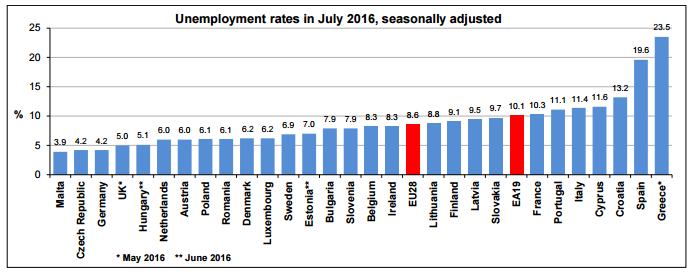
Eurostat has issued a publication to inform regarding the unemployment rate in Euro area for July.The euro area (EA19) seasonally-adjusted unemployment rate was 10.1% in July 2016, stable compared to June 2016 and down from 10.8% in July 2015. This remains the lowest rate recorded in the euro area since July 2011. The EU28 unemployment rate was 8.6% in July 2016, stable compared to June 2016 and down from 9.4% in July 2015. This remains the lowest rate recorded in the EU28 since March 2009. These figures are published by Eurostat, the statistical office of the European Union.  Eurostat estimates that 21.063 million men and women in the EU28, of whom 16.307 million were in the euro area, were unemployed in July 2016. Compared with June 2016, the number of persons unemployed decreased by 29 000 in the EU28 and by 43 000 in the euro area. Compared with July 2015, unemployment fell by 1.688 million in the EU28 and by 1.034 million in the euro area.

Member States
Among the Member States, the lowest unemployment rates in July 2016 were recorded in Malta (3.9%) as well as in the Czech Republic and Germany (both 4.2%). The highest unemployment rates were observed in Greece (23.5% in May 2016) and Spain (19.6%).  Compared with a year ago, the unemployment rate in July 2016 fell in twenty-four Member States, remained stable in Denmark, while it increased in Estonia (from 6.1% to 7.0% between June 2015 and June 2016), Austria (from 5.7% to 6.0%) and Belgium (from 8.1% to 8.3%). The largest decreases were registered in Cyprus (from 15.0% to 11.6%), Croatia (from 16.5% to 13.2%) and Spain (from 21.9% to 19.6%). In July 2016, the unemployment rate in the United States was 4.9%, stable compared to June 2016 and down from 5.3% in July 2015.
eu-unemployment-rate
Youth unemployment
In July 2016, 4.276 million young persons (under 25) were unemployed in the EU28, of whom 2.969 million were in the euro area. Compared with July 2015, youth unemployment decreased by 310 000 in the EU28 and by 136 000 in the euro area. In July 2016, the youth unemployment rate was 18.8% in the EU28 and 21.1% in the euro area, compared with 20.2% and 22.1% respectively in July 2015. In July 2016, the lowest rates were observed in Malta (7.1%) and Germany (7.2%), and the highest in Greece (50.3% in May 2016), Spain (43.9%) and Italy (39.2%).
Geographical information
The euro area (EA19) includes Belgium, Germany, Estonia, Ireland, Greece, Spain, France, Italy, Cyprus, Latvia, Lithuania, Luxembourg, Malta, the Netherlands, Austria, Portugal, Slovenia, Slovakia and Finland. The European Union (EU28) includes Belgium, Bulgaria, the Czech Republic, Denmark, Germany, Estonia, Ireland, Greece, Spain, France, Croatia, Italy, Cyprus, Latvia, Lithuania, Luxembourg, Hungary, Malta, the Netherlands, Austria, Poland, Portugal, Romania, Slovenia, Slovakia, Finland, Sweden and the United Kingdom.
Methods and definition
Eurostat produces harmonised unemployment rates for individual EU Member States, the euro area and the EU. These unemployment rates are based on the definition recommended by the International Labour Organisation (ILO). The measurement is based on a harmonised source, the European Union Labour Force Survey (LFS).
Based on the ILO definition, Eurostat defines unemployed persons as persons aged 15 to 74 who:
- are without work;
- are available to start work within the next two weeks;
- and have actively sought employment at some time during the previous four weeks.
The unemployment rate is the number of people unemployed as a percentage of the labour force. The labour force is the total number of people employed plus unemployed. In this news release unemployment rates are based on employment and unemployment data covering persons aged 15 to 74. The youth unemployment rate is the number of people aged 15 to 24 unemployed as a percentage of the labour force of the same age. Therefore, the youth unemployment rate should not be interpreted as the share of jobless people in the overall youth population.
Country notes
Germany, the Netherlands, Austria, Finland, Sweden and Iceland: the trend component is used instead of the more volatile seasonally adjusted data.  Denmark, Estonia, Hungary, Portugal, the United Kingdom and Norway: 3-month moving averages of LFS data are used instead of pure monthly indicators.

Friday, September 9, 2016

US president Barack Obama holds a joint press conference with prime minister Theresa May ahead of the G20 summit in Hangzhou on Sunday. Speaking of the consequences of Britain’s decision to leave the EU, Obama says that, while he still believes that the world “benefitted enormously” from the UK’s membership of the European Union, he would work with May to ensure the consequences of the vote “don’t end up unravelling” the strong trade relationship between the two nations

Thursday, September 8, 2016

 French president, Francois Hollande, will inaugurate the Airbus plant in Ghimbav on September 13th, according to sources close to the investors. According to Serge Durand, the CEO of Airbus Helicopters Industries, the first helicopter made in Ghimbav will only be delivered at the end of 2017, but starting with September 2016, the plant will become functional and operational. The company intends to bring in other projects to Braşov if the H215 project proves to be successful.   Serge Durand said: "For now, we have concluded a protocol with Romanian airlines- IAR Ghimbav, Aerostar, Aerotech and Turbomecanica - to become suppliers for the helicopter that will be manufactured in Romania, which will be entirely made out of parts manufactured in Romania".   Serge Durand also stated that Ghimbav will first of all manufacture the civilian version of H215, with production of the military version to be transferred in a few years from the factory in France to the one in Braşov. Moreover, in 2019, Durand hopes that over 30 Romanian engineers will be working on the design of the helicopters that will be manufactured in Ghimbav, with the company intending to develop an R&D center in Romania. The amount of the total investment in the new Airbus Helicopters project in Ghimbav is 55.7 million Euros, of which the aid of the Romanian state is a maximum of 5.2 million Euros. "We will reach 350 employees at the plant of in 2019, when we are going to start manufacturing 15 H215 helicopters a year", Durand further said.   Guillaume Faury, CEO Airbus Helicopters, said that in Ghimbav will be assembled the H215 helicopter, the latest member of the H aircraft family of the German French group, the "smaller" brother of H225. H215 is an advanced variant of the former AS332 Cie/L1e helicopter, which would be sold at "accessible prices", because "the costs are low".  Airbus Helicopters, a division of Airbus Group, offers solutions for civilian and military helicopters all over the world. The company has an operational fleet of approximately 12,000 helicopters operated by over 3,000 customers in approximately 154 countries. Airbus Helicopters has over 22,000 employees all over the world and has generated a revenue of 6.8 billion Euros in 2015. 

Wednesday, September 7, 2016

The annual inflation rate in the Eurozone has remained stable in August compared to July, at 0.2%, according to a preliminary estimate published on Wednesday by the European Statistics Office (Eurostat).  According to Eurostat, in the month of August, the most significant price increases were seem in food, alcohol and cigarettes, which have posted an annual increase of 1.3%, compared to 1.4% in July, followed by services, which have seen an annual increase of 1.1%, compared to 1.2% seen in July. On the other hand, energy prices have seen an annual decrease of 5.7% in August, compared to a decline of 6.7% seen in July.  Eurostat had previously announced that in July, compared to June 2016, annual inflation dropped in nine EU member countries, has remained stable in seven countries and has increased in 12 states, including Romania, according to Agerpres.  Eurostat has also announced on Wednesday that in July 2016, compared to June 2016, the unemployment rate has remained stable at 10.1% in the Eurozone, while in the European Union the unemployment rate has remained stable at 8.6%. Among the member states, the highest unemployment rates were seen in Greece, (23.5% in May 2016) and Spain (19.6%). On the opposite is Malta, with an unemployment rate of 3.9%, Czech Republic and Germany, both with 4.2%. Romania is below the EU average, with an unemployment rate of 6.1%. Compared to the situation in July 2015, the unemployment rate decreased in 24 member states, including Romania, has remained stable in Denmark and has increased in Estonia, Austria and Belgium.  In Romania's case, according to data notified by the National Statistics Institute, (INS), the annual inflation has remained in negative territory in July as well, at -0.8%, down from -0.7% in June. Calculated based on the harmonized consumer price index, the drop has been -0.3%, the INS states. The seasonally adjusted unemployment rate also stood at 6.1%, at the end of July, up 0.1 percentage points over the previous month (6%), according to the standards of the International Labor Bureau. 

Tuesday, September 6, 2016

Wall Street drew two conclusions from the news that the US jobs engine shifted down into a lower gear last month. The first – that a September increase in interest rates is now a non-starter – was almost certainly right.  Putting up the cost of borrowing so close to the presidential election in early November always looked like an outside bet. It would have taken thunderously good figures for job creation to have persuaded the more dove-ish policymakers at the Federal Reserve to move, and the ones released on Friday were average at best.  To be sure, the August non-farm payrolls have come in worse than expected for the past decade, suggesting that there might be some problem with the way the raw data is seasonally adjusted. What’s more, the two previous months – June and July – saw strong increases in demand for labour, so the three-month average for non-farm payrolls is running at a healthy 200,000. That could persuade some of the hawks at the Fed to move, but they will not be able to muster a majority. The second conclusion drawn by Wall Street is more questionable. That is the assumption that the rate rise some analysts had pencilled in for September has now simply been put back to a later date. Some economists believe the Fed won’t waste any time once US voters have chosen who will be Barack Obama’s successor at the White House; some think the central bank will wait until March next year. There is, though, a different way of looking at the numbers. For most of this year, the strength of the US labour market has been at odds with data showing the economy growing only slowly. Sooner or later, the theory went, growth would accelerate and come into line with employment numbers, so justifying higher interest rates.