There is now a growing band of politicians, entrepreneurs and policy strategists who argue that a basic income could potentially hold the solution to some of the big problems of our time. Some of these new converts have alighted upon the basic income as an answer to our fragmenting welfare state. They point to the increasingly precarious nature of today’s labour market for those in low-paid, low-skilled work: growing wage inequality, an increasing number of part-time and temporary jobs, and rogue employers routinely getting away with exploitative practices.Monday, February 20, 2017
There is now a growing band of politicians, entrepreneurs and policy strategists who argue that a basic income could potentially hold the solution to some of the big problems of our time. Some of these new converts have alighted upon the basic income as an answer to our fragmenting welfare state. They point to the increasingly precarious nature of today’s labour market for those in low-paid, low-skilled work: growing wage inequality, an increasing number of part-time and temporary jobs, and rogue employers routinely getting away with exploitative practices.Wednesday, August 24, 2016
Sunday, January 3, 2016
It’s an idea whose adherents over the centuries have ranged from socialists to libertarians to far-right mavericks. It was first proposed by Thomas Paine in his 1797 pamphlet, Agrarian Justice, as a system in which at the “age of majority” everyone would receive an equal capital grant, a “basic income” handed over by the state to each and all, no questions asked, to do with what they wanted.Monday, June 2, 2014
Unemployment is rising in Europe's two largest economies, with a shock jump in Germany and a new record high in France, according to the latest figures.Thursday, October 3, 2013
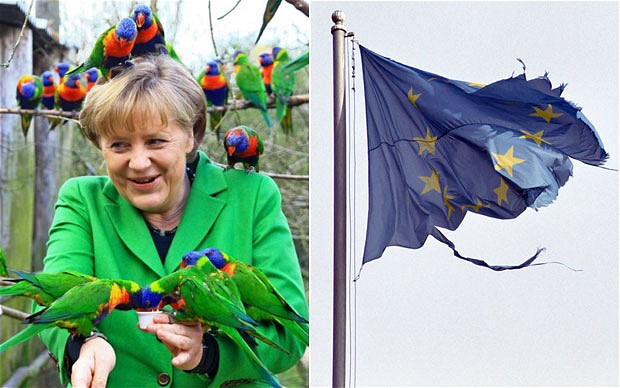
The truth about Merkel's 4th. Reich
Saturday, February 2, 2013
BERLIN - A third of Europeans have no savings at
all, while in Spain and Italy half of the population is using up money put
aside, a survey carried out by the German pollster TNS on behalf of ING Bank
shows. The study was carried out on over 14,000 adults in Austria, Belgium,
Czech Republic, France, Germany, Italy, Luxembourg, the Netherlands, Poland,
Romania, Slovakia, Spain, Turkey and the UK. The country with the fewest savers
was Romania, where almost half (48%) of respondents said they have no savings,
while Luxembourg had the most (89%). The evolution of personal savings in the
past year showed they decreased among 52 percent of Italians and 47 percent of
Spaniards. In Turkey and Great Britain, however, almost half of their citizens
were able to set aside more money in the past 12 months. Asked whether they
were happy with the state of their savings, Dutch and German were the most happy
(47% and 46%), while Czechs, Italians and Spaniards the most unhappy (38% and
36%). Most respondents - over two thirds - said they were not able to spend as
much on hobbies, clothes and body care. Education and health were the least
touched. On average, there are more Europeans who say they would be able to
live from their savings for three months (49%) than those who say they could not
(47%).Monday, August 13, 2012
"Indignados" in Spain
"Que se vayan todos," or "Away with all of them," became one of the slogans chanted by the tens of thousands of "Indignados" in Spain at protests last year. In addition to their eponymous outrage, many had one thing in common: Most were young and viewed themselves as victims of the crisis. Friday, August 3, 2012
More from the IMF: "The external position of the Euro area
as a whole has been close to balance, and only slightly weaker than the
estimated value consistent with fundamentals and desirable policies. However,
this masked, and continues to mask, substantial divergences across the Euro area
primarily financed from within the union, including by major banks with global
links. Germany currently has the world’s second largest current account surplus,
partly with the rest of the world, while Spain and (to a lesser extent) Italy
have deficits. Major estimated external imbalances that are regionally-financed
imply a need for substantial real and financial rebalancing within the Euro area
as well as a much more modest rebalancing by the bloc with the rest of the
world. Unsustainably large intra-Euro area imbalances were part of the global
boom-bust cycle, and the failure to resolve the Euro area crisis is causing
heightened stresses that are spilling over to other countries". -- Germany
is doing OK though, and have done since the Eurozone was created. No wonder
Merkel wants to preserve the status quo. The eurozone is on life-support, it
won't be long before the apparatus is switched off, but by then millions of
people in Spain, Portugal, Ireland, Italy, Greece et al will have had their
lives ruined by arrogant, stubborn eurocrats. ..... What's the youth population
of Europe? Say, around 100 million people (depending on how you define youth) of
which roughly 20 million are unemployed. Now take the quantitative easing (QE:
new money printed and issued, a taxpayer liability) amounts given to the banks,
and the other forms of money given to them in bank bailouts. £375 billion and
counting in the UK. Don't have close to hand, the QE, bank bailout, and other
monetary relief sums for the bad debt of banks given to Spain, Italy, Greece,
Ireland, and Portugal. Let's take a conservative estimate of a total of £600
billion: divide this by 20 million and you have £30,000 per unemployed youth.
The new money printed and issued by European governments if given directly to
the public instead of the banks would certainly wipe out unemployment for at
least a year or two. That would be even truer for the Non-Euro Countries,
forget about the rest of Europe. But we the public are such stupid, apathetic
sheep, we play along with this massive misdirection of financial resources by
the states, done for the banks, at your cost.Saturday, July 21, 2012
IMF calls on ECB to act --- The International Monetary Fund is pleading with the European Central Bank to do more to fix the eurozone crisis. In a report released at 2pm, the IMF said the ECB could, and should, do more to prevent the euro unravelling, arguing: The ECB can provide further defences against an escalation of the crisis. Tuesday, July 17, 2012
LONDON—The euro zone's financial plumbing is badly backed up—and none of
policy makers' efforts to clear it has worked.Friday, July 13, 2012
Bailout renegotiation - Greece
In February, European Union and international lenders had imposed strict
targets on spending and economic reforms on Greece in return for a 130bn euro
($171bn) rescue package - the country's second such bailout. But Greece's national wealth has shrunk for five years in a row and
unemployment remains high, which adds to the country's benefit costs while
reducing government income in terms of tax receipts.
Measures intended to reduce government debt, such as selling off state-run
companies and reducing the minimum wage, risk raising the number of jobless and
lowering household incomes, further damaging Greek economic growth . The government fears that the country is increasingly trapped in a vicious
cycle of internationally enforced austerity followed by shrinking wealth or
recession.Tuesday, July 10, 2012
I've been wondering about Norway; for many the model to emulate. Many of the numbers here come from Norsk Industris Konjunkturrapport 2012. It's an employers' association, so expect a center-right bias. I'd be delighted if a Norwegian were to comment.What's my take on Norway?
Thursday, February 9, 2012
Romania - New Government ( made of very young inexperienced individuals)
Romania’s new Government, led by Mihai Razvan Ungureanu, received a confidence vote in Parliament Thursday, allowing it to continue reforms pledged by the previous government under a deal with the International Monetary Fund, EU and World Bank. Lawmakers voted 237 to two to instate the new Cabinet. The Cabinet required the confidence vote of at least 232 lawmakers. The opposition did not attend the vote. STRAGE as it may be, the new cabinet is very young, and made of the former communist sibilings...HAVING NO EXPERIENCE IN ADMINISTRATION, or background in runing anything !!!!Friday, February 25, 2011
Staple foods became 20 to 40% more expensive between July 2010 and February 2011, shows the Z.F. index calculated based on prices in Bucharest hypermarkets. ZF selected 15 products whose price it has been following since 2008, once every six months, at the same Bucharest hypermarkets, Carrefour Orhideea and Real Afi Cotroceni. These products were chosen because they are most often to be found in Romanians' purchase basket. (Z.F.) In the calculation of this index, ZF chose one brand from each category of products, a brand that is well positioned in terms of market share, produced by one of the top-five players in the category. Therefore, one kilo of Băneasa flour costs 2.8 lei in February, 41.4% more than in July 2010. 1 Kilo of Lemarco sugar now costs 4.295 lei, compared with 3.28 lei, an increase of 30.9%. Similarly, the price of Floriol vegetable oil (1 litre) rose over 35%, from 5.11 lei to 6.91 lei. Data from the National Statistics Institute (INS) point to a 10.2% price increase for flour in the July 2010 - January 2011 period. Similarly, the increase amounted to 8.1% for sugar. The only products whose prices fell, of those analysed by ZF, were beer, mineral water, apples, with the decline amounting to 6.1%, 0.1% and 12.4% respectively.
Thursday, December 30, 2010

In 2009, developers completed retail projects totaling 195,000 sqm, according to CB Richard Ellis (CBRE) data.
Oradea Shopping City, Uvertura City Mall Botosani, Vitan Outlet Bucharest, Policolor Shopping Center Bucharest and Electroputere Shopping City Craiova are other projects scheduled for completion in 2011. Read more on http://www.mediafax.biz/. (Z.F.)euro, criza datoriilor de stat, euroscepticismul, monede nationale, renuntarea la euro, salvare euro, zona euro
Thursday, November 11, 2010
duri, mita, gaze, uniunea europeana,ministru,creditlitia,dosare,coruptie,interne,calificat, infractori,guvern,prezidenriale,dreapta,legea salarizarii unice,salarii,geoana,basescu,finante,tariceanu, socialism,liberalism,marea neagra,lege,europarlamentare,parlament,constitutie,curs,leu,dolar,euro, masuri anticriza,politica,fmi
UniCredit Ţiriac Bank ended the third quarter with 67 million RON (almost 16 million euro) net profit, down 6% compared with the same time last year. Nine months into the year, net profit amounted to 215 million RON (52 million euros), a 15% decline compared with 18% in the first half.Operating revenues exceeded one billion RON (245 million euros) nine months into the year, up 15%, while the credit portfolio rose by 13%, to 13.3 billion RON (3.1 billion euros). Midyear, the lending increase stood at 11%, with the Italian group continuing to apply the strategy designed to boost the loan market share.