Sunday, December 22, 2013

The "banking union" deal was announced, without the publication of detailed legal texts setting out how new structures would work, in the early hours of Thursday morning just ahead of an EU summit after talks between European finance ministers that lasted over 12 hours.
"We have been successful," said Rimantas Sadzius, Lithuania's finance minister, who chaired the talks. "It is an extremely complicated dossier. There is still room for simplification."
Michel Barnier, the French EU commissioner, hailed the agreement as breaking the "vicious circle between banks and sovereigns" but acknowledged concerns over the complexity of the new structures.
"Today is a big momentous day for banking union...we are introducing revolutionary change to Europe's finance sector," he said. "The commission does not agree on every point but real progress has been made."
Negotiations focused on the creation of a eurozone Single Resolution Mechanism (SRM) with the powers to close failing banks combined with a new financial supervisor for the eurozone under the auspices of the European Central Bank.
The talks were protracted because of deep divisions over who should have the last say over when a bank is to be wound up, combined with legal and practical difficulties of combining an EU regulation with a separate inter-government treaty to set the resolution body.
The commission and the ECB are concerned that complicated and unwieldy SRM structures, that have been defined by German objections over the mutualisation of banking risk, will not be able to take difficult decisions to close a bank quickly or secretly enough to prevent financial chaos.
The text of the agreement leaves it open for governments, meeting in a council of finance ministers, to block decisions by the SRM's board raising question over whether difficult decisions can be taken without blocking vetoes led by larger countries, such as Germany or France.
"Decisions by the board would enter into force within 24 hours after their adoption, unless the council, acting by simple majority on a proposal by the commission, objects or calls for changes," said the agreement.
The "banking union" proposals were drawn up in response to the financial and eurozone debt crises that brought down many banks and nearly destroyed the EU's single currency as governments had to be bailed out after rescuing their banks.
The key sticking points, which have yet to be conclusively resolved, have deeply divided Germany and France over the question of will have the final say in deciding to close a bank and how this will be paid for.
The agreement also fell short of creating a "common backstop" for a "single resolution fund" to help with the costs of bank failure in a deal that has left lingering questions over whether "banking union" can actually work.
During talks on Tuesday, Germany made a major concession to establish a common fund by 2025 that can provide mutualised support from eurozone governments to the bank resolution fund should its limited resources be overwhelmed in a crisis.
The climbdown was an important victory for France, Italy and the European Commission but there is no agreement or detail of how much the backstop will be or what form it should take.
"During this transitional phase, a common backstop will be developed, which would become fully operational at the latest after ten years. The backstop would facilitate borrowings by the fund. It would ultimately be reimbursed by the banking sector through levies, including ex-post," said the agreement.
In the meantime, an agreed fund comprising "national compartments" will be built up over 10 years from 2015 onwards from bank levies. It will only total €55bn (£46bn) by 2025, raising fears that it will not be enough to support a bank's restructuring in the event of a crisis.

Saturday, December 21, 2013

EXPORT-IMPORT BANK BOARD ADOPTS REVISED ENVIRONMENTAL GUIDELINES TO REDUCE GREENHOUSE GAS EMISSIONS  Washington, DC — The board of directors of the Export-Import Bank of the United States (Ex-Im Bank) today adopted revisions to its environmental procedures and guidelines governing high-carbon intensity projects, aligning the Bank with President Obama’s goal of reducing carbon pollution, while maintaining the Bank’s focus on continuing to help create and support American export-related jobs.
“No one has been more supportive of U.S. exports and the American jobs they produce and maintain than this Bank and this board. Since 2009, we have supported nearly 1.2 million jobs.” said Fred P. Hochberg, Ex-Im chairman and president. “We can’t do it, however, without considering the environmental costs associated with transactions.”
The revised guidelines adopted today require carbon capture and storage in most countries in order to secure Bank financing for coal-fired power plants, but would provide flexibility for the Bank with respect to the important energy needs of the poorest countries in the world.
The policy revisions were drafted by Ex-Im Bank staff and reviewed extensively by exporters, the public, leading environmental groups, the Administration and other federal agencies through an extensive and transparent vetting process.
“The Bank engages in an important balancing act — in supporting our exporters, we have to weigh the potential impacts on the environment associated with our financing,” Hochberg said. “This balancing act is a Congressional mandate, is a directive in our Charter, is part of our mission and it is something we at the Bank take seriously.”
Hochberg noted that: “Our proposed guidelines would balance the Bank’s obligations to its many different stakeholders and also its efforts to support the growth of export-related U.S. jobs.”
“Without guidelines or limits, ever-increasing numbers of new coal plants worldwide will just continue to emit more carbon pollution into the air we breathe,” said Hochberg. “But America cannot do this alone. I strongly support the Administration’s efforts to build an international consensus such that other nations follow our lead in restricting financing of new coal-fired power plants.”

Ex-Im has been a leader among the world’s export credit agencies (ECAs) in adopting measures to protect the environment while financing exports.
In 1995 the Bank was the first ECA to adopt environmental procedures and guidelines governing its export financing. In 1999 the Bank began tracking and publicly reporting projected carbon emissions produced by projects it financed. Even today Ex-Im is the only ECA that tracks and reports carbon emissions. In 2009 the Bank approved a formal carbon policy, and in 2010 it approved supplemental guidelines for high-carbon intensity projects.
The guideline revisions approved today are not designed to impact mining projects or coal exports produced by American coal miners. Ex-Im staff have worked with other agencies to ensure that the flexibility of these guidelines would be consistent with those of other federal agencies.
In addition to approving the revisions to its environmental guidelines, the board today approved seven transactions that together will support more than 11,200 U.S. export-related jobs.
ABOUT EX-IM BANK:
Ex-Im Bank is an independent federal agency that creates and maintains U.S. jobs by filling gaps in private export financing at no cost to American taxpayers. In the past five years (from Fiscal Year 2008), Ex-Im Bank has earned for U.S. taxpayers nearly $1.6 billion above the cost of operations. The Bank provides a variety of financing mechanisms, including working capital guarantees, export-credit insurance and financing to help foreign buyers purchase U.S. goods and services.

Ex-Im Bank approved $35.8 billion in total authorizations in FY 2012 – an all-time Ex-Im record. This total includes more than $6.1 billion directly supporting small-business export sales – also an Ex-Im record. Ex-Im Bank's total authorizations are supporting an estimated $50 billion in U.S. export sales and approximately 255,000 American jobs in communities across the country.

Friday, December 20, 2013

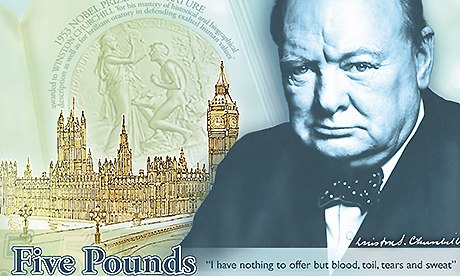
Polymer five pound note
Concept design for new polymer £5 note featuring former British leader Winston Churchill. Photograph: AP
Mark Carney, the governor of the Bank of England, has formally announced that Britain will switch to using plastic banknotes in 2016, ending 320 years of paper money.
After a public consultation in which 87% of the 13,000 respondents backed the new-style currency, the Bank said it would introduce "polymer" notes, as it prefers to call them, in two years' time, starting with the new £5 note featuring Winston Churchill in 2016 and the Jane Austen £10 a year later.
Speaking at a press conference in the Bank's Threadneedle Street headquarters, Carney said: "Our polymer notes will combine the best of progress and tradition. They will be more secure from counterfeiting and more resistant to damage while celebrating the history and tradition that is important both to the Bank and the nation as a whole."
The move follows Carney's native Canada, where plastic notes are being rolled out, and Australia, where they have been in circulation for more than two decades.
Carney launched a public consultation on polymer banknotes, seen as cleaner and more durable, shortly after arriving at the Bank this summer. However, the Bank's notes division has been considering plastic money for several years.
Bank officials have been touring shopping centres and business groups around the country with prototype notes to canvas public opinion.  The Bank has promoted its polymer notes, featuring a see-through window and other new security features, as less threadbare and tougher to counterfeit. It has sought to quell concerns about the environmental impact of printing on plastic by suggesting they can last up to two-and-a-half times longer than the cotton-paper notes in circulation at the moment. The durability will also compensate for the higher production costs and save an estimated £100m, the Bank claims. Its laboratory tests showed polymer banknotes only begin to shrink and melt at 120C, so they would fare better in washing machines but could be damaged by a hot iron.

Thursday, December 19, 2013

In Greece, the govt is starting to make public the conditions under which homes could be foreclosed. Kathimerini:
Foreclosures will not be allowed if: The taxable value of the property is under 200,000 euros; gross household income (not including social security contributions, income tax and solidarity tax) is no more than 35,000 euros; and the owner’s total assets are under 270,000 euros.
The criteria will be relaxed a little for families with three or more children.
The ministry also proposes that those with a household income of less than 15,000 euros per year should pay a monthly mortgage payment of 10 percent of their net monthly income.
Those earning between 15,000 and 35,000 euros per year should pay monthly mortgage payments that amount to 10 percent of their first 15,000 euros of income and 20 percent of anything they earn above that.
The unemployed will be allowed to forgo monthly payments until they have an income.
Pasok is accepting those criteria. Some ND MPs are still reluctant. If those are indeed the criteria implemented, it seems protective. As often in Greece, salaried people will be more easily hit than professionals since their income is available.
The German government has recently signaled willingness to compromise on the issue of which body would be responsible for deciding if a bank needs to be liquidated. Initially, a newly created committee with representatives of national authorities would assume this responsibility, but the formal decision could then be left to an EU body like the European Commission. In disputed cases, the European Council, the powerful body that includes the leaders of the 28 member states, would be brought in to arbitrate.
Berlin has also agreed in principle to calls for a liquidation fund for failing financial institutions that would have a capacity of €55 billion ($76 billion) within 10 years. But the EU member states are supposed to agree among themselves on how these funds can actually be used, with greater voting weight being given to more populous countries. This idea hasn't gone over well with some governments, because they fear that Berlin, working together with a few small countries, would be able to block decisions. In addition, the money in the fund would not be available for use until it is transformed into an official EU instrument in 10 years' time.
Under the "liability cascade" plan being promoted by Schäuble, however, bank shareholders will be required to pay part of the costs for liquidating a bank starting in January 2016. Owners and creditors would first be required to cover any liquidation costs before any taxpayer money could be brought in. Berlin has had success so far in negotiations on this point. The German government had wanted to introduce this rule as early as 2015. But other member states like Italy pleaded for it to start at the earliest in 2018. They fear the move to start in 2015 might frighten investors.
And there's one additional play to safety: Germany continues to oppose using the European Stability Mechanism, the permanent euro-zone rescue fund, as a backstop for fledgling banks. Other countries have suggested employing the fund's billions of euros as part of a future banking union resolution mechanism.

Wednesday, December 18, 2013

People using bitcoins and other virtual currencies are on their own when it comes to losses, the EU banking watchdog said on Friday in a formal warning to consumers on the risks of using unregulated online currencies. The European Banking Authority said there was no protection or compensation for people whose "digital wallets" are hacked, or when a transfer of virtual money goes wrong or a platform is shut. The warning follows a similar announcement from the Bank of France. The EBA stopped short of telling consumers not to use online currency markets but said if they end up out of pocket there will be no safety net like compensation given to deposit holders when a mainstream EU bank goes bust.
"Currently, no specific regulatory protections exist in the EU that would protect consumers from financial losses if a platform that exchanges or holds virtual currencies fails or goes out of business," EBA said in a statement.

Tuesday, December 17, 2013

Ireland is to regain its sovereignty after three years under the thumb of the EU-IMF Troika, the first of the eurozone crisis states to return to the free market.
The crippled Celtic Tiger has been subject to intrusive controls after a banking collapse forced it to seek a €78bn loan package from the EU and the International Monetary Fund in November 2010, compelled to cut wages and inflict a fiscal squeeze of 19pc of GDP. The country will not break free of its shackles entirely. Inspectors will continue to carry out visits twice a year until 2031 “at the earliest” under a surveillance mechanism. Ireland will face binding constraints under Europe’s deflationary Fiscal Compact.  The "poster child" of EU austerity, Ireland has taken its medicine stoically without street violence or a lurch towards extremism, thanks to a close-knit tripartite system of trade unions, business and the government working together.
European officials have hailed Ireland’s recovery as a vindication of their strategy of “internal devaluation”, a policy of wage cuts aimed at clawing back lost competitiveness within monetary union. Yet it remains far from clear whether Ireland is really out of the woods or whether debt-stricken countries in southern Europe can replicate the feat. Ireland has a highly-competitive export base, akin to Asia’s tigers. It is the fruit of an industrial strategy 20 years ago that lured in American software and pharmaceutical firms, and built a financial service sector. Exports equal 108pc of GDP, compared with 39pc for Portugal, 32pc for Spain, 30pc for Italy and 27pc for Greece.  This trade "gearing" makes it far easier for Ireland to export its way out of trouble. The current account surplus is 4pc of GDP, though the Viagra and Lipitor “patent cliff” has cut exports by 17pc this year.  Ireland does not have an overvalued currency, unlike EMU’s Latin bloc. Its crisis stemmed from a credit bubble, caused by super-loose monetary policy set for German needs. Real interest rates averaged -1pc for seven years, a disaster for a young fast-growing economy.